A 2.0 kg object is moving to the right with a speed of when it experiences the force shown in FIGURE EX11.9. What are the object's speed and direction after the force ends?
Ch 11: Impulse and Momentum
Knight Calc5th EditionPhysics for Scientists and EngineersISBN: 9780137344796Non è quello che usi tu?Cambia libro di testo
Capitolo 11, Problema 6
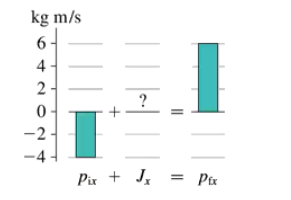
FIGURE EX11.6 is an incomplete momentum bar chart for a collision that lasts 10 ms. What are the magnitude and direction of the average collision force exerted on the object?

Guida verificata passo dopo passo1
Step 1: Analyze the momentum bar chart. The initial momentum (P_ix) is represented by the shaded bar on the left, which corresponds to +6 kg·m/s. The final momentum (P_fx) is represented by the shaded bar on the right, which corresponds to -3 kg·m/s.
Step 2: Calculate the change in momentum (ΔP). The change in momentum is given by ΔP = P_fx - P_ix. Substitute the values: ΔP = (-3 kg·m/s) - (+6 kg·m/s).
Step 3: Use the impulse-momentum theorem to relate the change in momentum to the average collision force. The impulse-momentum theorem states that J_x = F_avg × Δt, where J_x is the impulse, F_avg is the average force, and Δt is the time duration of the collision.
Step 4: Substitute the value of ΔP for J_x, as impulse is equal to the change in momentum. Also, substitute the given time duration of the collision, Δt = 10 ms = 0.01 s, into the equation.
Step 5: Rearrange the equation to solve for F_avg. F_avg = ΔP / Δt. Substitute the values of ΔP and Δt to find the magnitude and direction of the average collision force.

Risposta video verificata per un problema simile:
Questa soluzione video è stata consigliata dai nostri tutor come utile per risolvere questo problema.
Durata del video:
4mConcetti chiave
Ecco i concetti essenziali che devi comprendere per rispondere correttamente alla domanda.
Momentum
Momentum is a vector quantity defined as the product of an object's mass and its velocity. It is represented by the symbol 'p' and is crucial in understanding collisions, as it is conserved in isolated systems. The momentum before and after a collision can be analyzed to determine the effects of the collision on the objects involved.
Video consigliato:
Percorso guidato
Intro to Momentum
Impulse
Impulse is defined as the change in momentum of an object when a force is applied over a period of time. It is calculated as the product of the average force and the time duration of the force application. In the context of collisions, impulse helps quantify the effect of the collision force on the momentum of the objects involved.
Video consigliato:
Percorso guidato
Impulse & Impulse-Momentum Theorem
Average Force
Average force is the total impulse experienced by an object divided by the time duration over which the force acts. It provides a measure of how much force is exerted on an object during a collision. Understanding average force is essential for analyzing the dynamics of collisions and determining the resulting motion of the objects involved.
Video consigliato:
Percorso guidato
Solving Constant and Average Velocity Problems
Pratica correlata
Domanda del libro di testo
2252
views
Domanda del libro di testo
What is the impulse on a 3.0 kg particle that experiences the force shown in FIGURE EX11.4?
2454
views
1
comments
Domanda del libro di testo
Far in space, where gravity is negligible, a 425 kg rocket traveling at 75 m/s in the +x-direction fires its engines. FIGURE EX11.10 shows the thrust force as a function of time. The mass lost by the rocket during these 30 s is negligible. At what time does the rocket reach its maximum speed? What is the maximum speed?
1992
views
Domanda del libro di testo
In FIGURE EX11.5, what value of Fmax gives an impulse of 6.0 N s?
2454
views
Domanda del libro di testo
What impulse does the force shown in FIGURE EX11.3 exert on a 250 g particle?
2139
views
Domanda del libro di testo
A 2.0 kg object is moving to the right with a speed of 1.0 m/s when it experiences the force shown in FIGURE EX11.8. What are the object's speed and direction after the force ends?
2227
views