Ch 11: Impulse and Momentum
Knight Calc - Physics for Scientists and Engineers 5th Edition
Knight Calc5th EditionPhysics for Scientists and EngineersISBN: 9780137344796Non è quello che usi tu?Cambia libro di testo
Capitolo 11, Problema 4

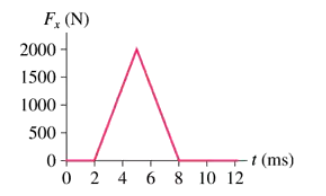
What is the impulse on a 3.0 kg particle that experiences the force shown in FIGURE EX11.4?

Guida verificata passo dopo passo
1
Step 1: Recall the formula for impulse, which is the integral of force over time. Mathematically, impulse (J) is given by: J=∫tfFdt, where F is the force and t is time.
Step 2: Analyze the graph provided. The force varies with time, forming two distinct triangular regions. The first triangle spans from t=0 to t=6, and the second triangle spans from t=6 to t=18. The impulse can be calculated by finding the area under the force-time graph.
Step 3: Calculate the area of the first triangle. The formula for the area of a triangle is 12×base×height. Here, the base is 6 seconds and the height is 5 N.
Step 4: Calculate the area of the second triangle. Again, use the formula for the area of a triangle. The base is 12 seconds (from 6 to 18) and the height is 5 N.
Step 5: Add the areas of the two triangles to find the total impulse. The impulse is equal to the sum of these areas, which represents the total change in momentum of the particle.

Risposta video verificata per un problema simile:

Questa soluzione video è stata consigliata dai nostri tutor come utile per risolvere questo problema.
Durata del video:
2m

Concetti chiave

Ecco i concetti essenziali che devi comprendere per rispondere correttamente alla domanda.

Impulse

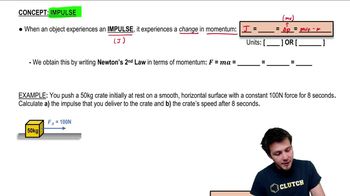
Impulse is defined as the change in momentum of an object when a force is applied over a period of time. It is mathematically expressed as the product of the average force and the time duration during which the force acts. Impulse can also be calculated as the area under the force-time graph, which represents the total effect of the force on the object.
Video consigliato:
Percorso guidato
06:00
Impulse & Impulse-Momentum Theorem

Force-Time Graph

A force-time graph visually represents how a force varies with time. The area under the curve of this graph corresponds to the impulse experienced by the object. In the provided graph, the shape indicates that the force is applied in a pulsed manner, which can be analyzed to determine the total impulse by calculating the area of the triangular and rectangular sections.
Video consigliato:
Percorso guidato
05:59
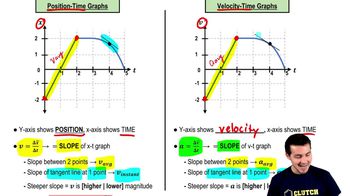
Velocity-Time Graphs & Acceleration

Momentum

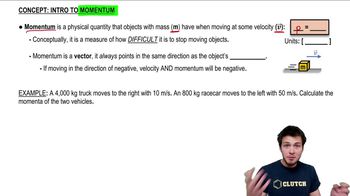
Momentum is the product of an object's mass and its velocity, representing the quantity of motion an object possesses. It is a vector quantity, having both magnitude and direction. The change in momentum of an object is directly related to the impulse applied to it, as described by the impulse-momentum theorem, which states that impulse equals the change in momentum.
Video consigliato:
Percorso guidato
05:17
Intro to Momentum