Ch 18: A Macroscopic Description of Matter
Knight Calc - Physics for Scientists and Engineers 5th Edition
Knight Calc5th EditionPhysics for Scientists and EngineersISBN: 9780137344796Non è quello che usi tu?Cambia libro di testo
Capitolo 18, Problema 37b

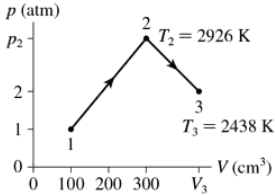
0.0050 mol of gas undergoes the process 1→2→3 shown in FIGURE EX18.37. What are pressure p2?

Guida verificata passo dopo passo
1
Step 1: Identify the given data for state B from the diagram: Volume (V_B = 4.00 L) and Temperature (T_B = 620 K). The number of moles of gas is also provided as n = 0.0050 mol.
Step 2: Use the Ideal Gas Law, which is expressed as: PV=nRT, where P is pressure, V is volume, n is the number of moles, R is the universal gas constant (R = 0.0821 L·atm/(mol·K)), and T is temperature.
Step 3: Rearrange the Ideal Gas Law to solve for pressure P_B: PB=nRTBVB.
Step 4: Substitute the known values into the equation: n = 0.0050 mol, R = 0.0821 L·atm/(mol·K), T_B = 620 K, and V_B = 4.00 L.
Step 5: Perform the calculation using the substituted values to find P_B. Ensure units are consistent throughout the calculation (e.g., L, atm, mol, K).

Risposta video verificata per un problema simile:

Questa soluzione video è stata consigliata dai nostri tutor come utile per risolvere questo problema.
Durata del video:
3m

Concetti chiave

Ecco i concetti essenziali che devi comprendere per rispondere correttamente alla domanda.

Ideal Gas Law

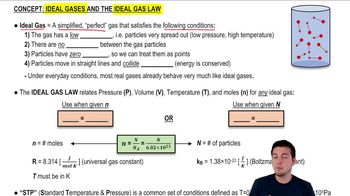
The Ideal Gas Law relates the pressure, volume, temperature, and number of moles of a gas through the equation PV = nRT. This law is fundamental in understanding the behavior of gases under various conditions and is essential for calculating properties like pressure in different states of a gas.
Video consigliato:
Percorso guidato
07:21
Ideal Gases and the Ideal Gas Law

Pressure-Volume Relationship

The pressure-volume relationship, often described by Boyle's Law, states that for a given amount of gas at constant temperature, the pressure of the gas is inversely proportional to its volume. This concept is crucial for analyzing processes in the provided graph, particularly when determining pressure at different volumes.
Video consigliato:
Percorso guidato
17:04
Pressure and Atmospheric Pressure

Thermodynamic Processes

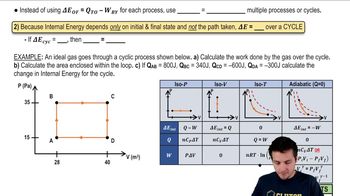
Thermodynamic processes describe the changes in state variables of a system, such as pressure, volume, and temperature. Understanding the types of processes (isothermal, adiabatic, etc.) helps in analyzing the transitions between states A, B, and C in the graph, which is key to finding the pressure p₂.
Video consigliato:
Percorso guidato
08:45
Properties of Cyclic Thermodynamic Processes