Ch 18: A Macroscopic Description of Matter
Knight Calc - Physics for Scientists and Engineers 5th Edition
Knight Calc5th EditionPhysics for Scientists and EngineersISBN: 9780137344796Non è quello che usi tu?Cambia libro di testo
Capitolo 18, Problema 40

A sealed container holds 3.2 g of oxygen at 1 atm pressure and 20°C. The gas first undergoes an isobaric process that doubles the absolute temperature, then an isothermal process that halves the pressure. What is the final volume of the gas in L?

Guida verificata passo dopo passo
1
Step 1: Convert the given mass of oxygen (3.2 g) into moles using the molar mass of oxygen (O₂). The molar mass of O₂ is approximately 32 g/mol. Use the formula: \( n = \frac{m}{M} \), where \( n \) is the number of moles, \( m \) is the mass, and \( M \) is the molar mass.
Step 2: Use the ideal gas law \( PV = nRT \) to calculate the initial volume of the gas. Here, \( P \) is the pressure (1 atm), \( n \) is the number of moles (calculated in Step 1), \( R \) is the ideal gas constant (0.0821 L·atm/(mol·K)), and \( T \) is the absolute temperature (convert 20°C to Kelvin by adding 273.15). Solve for \( V \): \( V = \frac{nRT}{P} \).
Step 3: For the isobaric process, the pressure remains constant, and the absolute temperature doubles. Use the relationship for isobaric processes: \( \frac{V_2}{V_1} = \frac{T_2}{T_1} \), where \( V_2 \) is the volume after the isobaric process, \( V_1 \) is the initial volume, \( T_2 \) is the final temperature (double the initial absolute temperature), and \( T_1 \) is the initial absolute temperature. Solve for \( V_2 \).
Step 4: For the isothermal process, the temperature remains constant, and the pressure is halved. Use the relationship for isothermal processes: \( P_1V_1 = P_2V_2 \), where \( P_1 \) and \( V_1 \) are the pressure and volume after the isobaric process, and \( P_2 \) and \( V_2 \) are the pressure and volume after the isothermal process. Solve for the final volume \( V_2 \).
Step 5: Combine the results from the isobaric and isothermal processes to determine the final volume of the gas in liters. Ensure all units are consistent throughout the calculations.

Risposta video verificata per un problema simile:

Questa soluzione video è stata consigliata dai nostri tutor come utile per risolvere questo problema.
Durata del video:
10m

Concetti chiave

Ecco i concetti essenziali che devi comprendere per rispondere correttamente alla domanda.

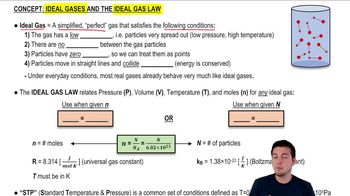
Ideal Gas Law

The Ideal Gas Law relates the pressure, volume, temperature, and number of moles of a gas through the equation PV = nRT. This law is fundamental for understanding gas behavior under varying conditions, allowing us to calculate one property if the others are known. In this question, it will help determine the final volume after the gas undergoes changes in temperature and pressure.
Video consigliato:
Percorso guidato
07:21
Ideal Gases and the Ideal Gas Law

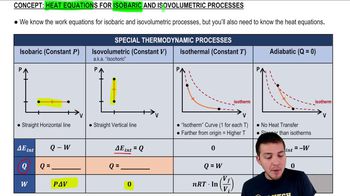
Isobaric Process

An isobaric process is a thermodynamic process in which the pressure remains constant while the volume and temperature may change. In this scenario, the gas first undergoes an isobaric process that doubles its absolute temperature, which directly affects its volume according to the Ideal Gas Law. Understanding this concept is crucial for calculating the intermediate state of the gas before the next process.
Video consigliato:
Percorso guidato
06:44
Heat Equations for Isobaric & Isovolumetric Processes

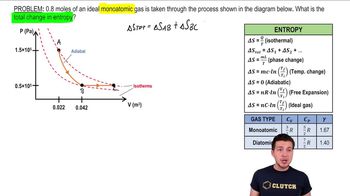
Isothermal Process

An isothermal process occurs at a constant temperature, meaning that any change in pressure will result in a corresponding change in volume, as described by Boyle's Law (PV = constant). In this question, after the isobaric process, the gas undergoes an isothermal process that halves the pressure, which will further affect the volume. Recognizing how these processes interact is essential for finding the final volume of the gas.
Video consigliato:
Percorso guidato
06:13
Entropy & Ideal Gas Processes