
The total lung capacity of a typical adult is 5.0 L. Approximately 20% of the air is oxygen. At sea level and at a body temperature of 37°C, how many oxygen molecules do the lungs contain at the end of a strong inhalation?
Ch 18: A Macroscopic Description of Matter
Knight Calc5th EditionPhysics for Scientists and EngineersISBN: 9780137344796Non è quello che usi tu?Cambia libro di testo
Capitolo 18, Problema 25d
A 20-cm-diameter cylinder that is 40 cm long contains 50 g of oxygen gas at 20°C. What is the reading of a pressure gauge attached to the tank?
Guida verificata passo dopo passo1
Step 1: Convert the given dimensions of the cylinder into SI units. The diameter is 20 cm, so the radius is 10 cm or 0.1 m. The length of the cylinder is 40 cm or 0.4 m. Use these values to calculate the volume of the cylinder using the formula for the volume of a cylinder: \( V = \pi r^2 h \), where \( r \) is the radius and \( h \) is the height.
Step 2: Convert the mass of oxygen gas into moles. The given mass is 50 g, and the molar mass of oxygen (O₂) is approximately 32 g/mol. Use the formula \( n = \frac{m}{M} \), where \( n \) is the number of moles, \( m \) is the mass, and \( M \) is the molar mass.
Step 3: Use the ideal gas law \( PV = nRT \) to calculate the pressure \( P \). Rearrange the formula to solve for \( P \): \( P = \frac{nRT}{V} \). Here, \( R \) is the ideal gas constant (8.314 J/(mol·K)), \( T \) is the temperature in Kelvin, and \( V \) is the volume of the cylinder. Convert the temperature from Celsius to Kelvin using \( T(K) = T(°C) + 273.15 \).
Step 4: Substitute the values for \( n \), \( R \), \( T \), and \( V \) into the equation to calculate the pressure \( P \). Ensure all units are consistent (e.g., volume in cubic meters, temperature in Kelvin).
Step 5: The pressure gauge measures the gauge pressure, which is the absolute pressure minus atmospheric pressure. Subtract the atmospheric pressure (approximately 101,325 Pa) from the calculated absolute pressure to find the gauge pressure.

Risposta video verificata per un problema simile:
Questa soluzione video è stata consigliata dai nostri tutor come utile per risolvere questo problema.
Durata del video:
8mConcetti chiave
Ecco i concetti essenziali che devi comprendere per rispondere correttamente alla domanda.
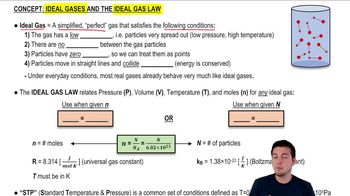
Ideal Gas Law
The Ideal Gas Law relates the pressure, volume, temperature, and number of moles of a gas through the equation PV = nRT. Here, P is pressure, V is volume, n is the number of moles, R is the ideal gas constant, and T is temperature in Kelvin. This law is fundamental for calculating the pressure of gases under various conditions.
Video consigliato:
Percorso guidato
Ideal Gases and the Ideal Gas Law
Volume of a Cylinder
The volume of a cylinder can be calculated using the formula V = πr²h, where r is the radius and h is the height. In this case, the diameter of the cylinder is given, so the radius can be found by dividing the diameter by two. Understanding how to calculate the volume is essential for determining the amount of gas present in the cylinder.
Video consigliato:
Percorso guidato
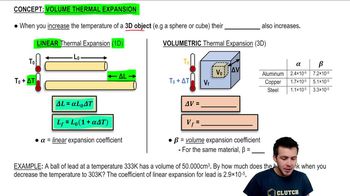
Volume Thermal Expansion
Pressure Measurement
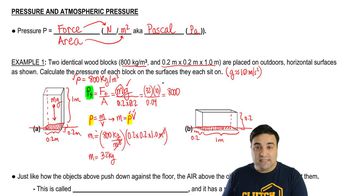
Pressure is defined as the force exerted per unit area and is commonly measured in units such as pascals (Pa) or atmospheres (atm). In the context of gases, pressure can be influenced by the amount of gas, its temperature, and the volume it occupies. Accurate pressure readings are crucial for understanding the behavior of gases in confined spaces.
Video consigliato:
Percorso guidato
Pressure and Atmospheric Pressure
Pratica correlata
Domanda del libro di testo
2776
views
Domanda del libro di testo
A gas with initial state variables p1, V1, and T1 expands isothermally until V2 = 2V1. What are p2?
1611
views
Domanda del libro di testo
A 20-cm-diameter cylinder that is 40 cm long contains 50 g of oxygen gas at 20°C. What is the number density of the oxygen?
1618
views
1
rank
Domanda del libro di testo
A gas with initial state variables p1, V1, and T1 is cooled in an isochoric process until p2 = (1/3)p1. What are V2?
1854
views
Domanda del libro di testo
A gas with initial state variables p1, V1, and T1 expands isothermally until V2 = 2V1. What are T1?
1641
views
Domanda del libro di testo
The solar corona is a very hot atmosphere surrounding the visible surface of the sun. X-ray emissions from the corona show that its temperature is about 2×10⁶ K. The gas pressure in the corona is about 0.03 Pa. Estimate the number density of particles in the solar corona.
2367
views
