Ch 18: A Macroscopic Description of Matter
Knight Calc - Physics for Scientists and Engineers 5th Edition
Knight Calc5th EditionPhysics for Scientists and EngineersISBN: 9780137344796Non è quello che usi tu?Cambia libro di testo
Capitolo 18, Problema 24

The solar corona is a very hot atmosphere surrounding the visible surface of the sun. X-ray emissions from the corona show that its temperature is about 2×10⁶ K. The gas pressure in the corona is about 0.03 Pa. Estimate the number density of particles in the solar corona.

Guida verificata passo dopo passo
1
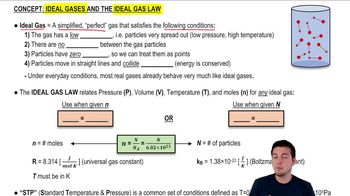
Start by identifying the ideal gas law, which relates pressure, number density, temperature, and the Boltzmann constant: P = nkT, where P is the pressure, n is the number density, k is the Boltzmann constant, and T is the temperature.
Rearrange the ideal gas law to solve for the number density n: n = PkT.
Substitute the given values into the equation: P = 0.03 Pa, T = 2 × 10⁶ K, and k = 1.38 × 10⁻²³ J/K (Boltzmann constant).
Perform the substitution: n = 0.031.38 × 10-23 × 2 × 106.
Simplify the expression to calculate the number density n. This will give the estimated number of particles per cubic meter in the solar corona.

Risposta video verificata per un problema simile:

Questa soluzione video è stata consigliata dai nostri tutor come utile per risolvere questo problema.
Durata del video:
6m

Concetti chiave

Ecco i concetti essenziali che devi comprendere per rispondere correttamente alla domanda.

Ideal Gas Law

The Ideal Gas Law relates pressure, volume, temperature, and number of particles in a gas. It is expressed as PV = nRT, where P is pressure, V is volume, n is the number of moles, R is the ideal gas constant, and T is temperature in Kelvin. This law allows us to estimate the number density of particles by rearranging the equation to find n/V, which is crucial for understanding the conditions in the solar corona.
Video consigliato:
Percorso guidato
07:21
Ideal Gases and the Ideal Gas Law

Number Density

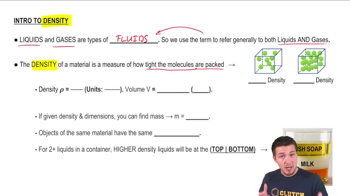
Number density is defined as the number of particles per unit volume, typically expressed in particles per cubic meter. It provides insight into the concentration of particles in a given space, which is essential for analyzing the properties of gases, including those in the solar corona. By using the Ideal Gas Law, we can calculate the number density from the known pressure and temperature of the corona.
Video consigliato:
Percorso guidato
8:13
Intro to Density

Thermal Equilibrium

Thermal equilibrium occurs when a system's temperature is uniform throughout, meaning that energy is distributed evenly among particles. In the context of the solar corona, the high temperature of about 2×10^6 K indicates that the particles are in rapid motion, contributing to the gas pressure. Understanding thermal equilibrium helps explain the behavior of the corona's plasma and its interactions with electromagnetic radiation, such as X-rays.
Video consigliato:
Percorso guidato
05:21
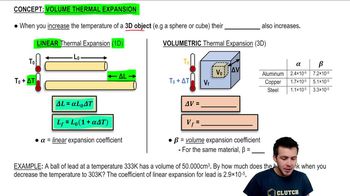
Volume Thermal Expansion