
Ch 20: The Micro/Macro Connection
Knight Calc - Physics for Scientists and Engineers 5th Edition
Knight Calc5th EditionPhysics for Scientists and EngineersISBN: 9780137344796Non è quello che usi tu?Cambia libro di testo
Capitolo 20, Problema 43

2.0 mol of helium at 280℃ undergo an isobaric process in which the helium entropy increases by 35 J/K. What is the final temperature of the gas?

Guida verificata passo dopo passo
1
Step 1: Convert the initial temperature from Celsius to Kelvin. Use the formula: T=TC+273.15. This ensures the temperature is in the correct unit for thermodynamic calculations.
Step 2: Recall the formula for entropy change in an isobaric process for an ideal gas: ΔS=nCpln(Tf/Ti), where n is the number of moles, Cp is the molar heat capacity at constant pressure, Ti is the initial temperature, and Tf is the final temperature.
Step 3: For helium, a monatomic ideal gas, the molar heat capacity at constant pressure is Cp=5R/2, where R is the universal gas constant (8.314 J/mol·K). Substitute this value into the entropy formula.
Step 4: Rearrange the formula to solve for the final temperature Tf: Tf=Ti·exp(ΔS/(nCp)). Substitute the values for ΔS, n, Cp, and Ti into the equation.
Step 5: Perform the calculation to find the final temperature Tf. Ensure all units are consistent throughout the calculation (e.g., Kelvin for temperature, J/K for entropy).

Risposta video verificata per un problema simile:

Questa soluzione video è stata consigliata dai nostri tutor come utile per risolvere questo problema.
Durata del video:
7m

Concetti chiave

Ecco i concetti essenziali che devi comprendere per rispondere correttamente alla domanda.

Isobaric Process

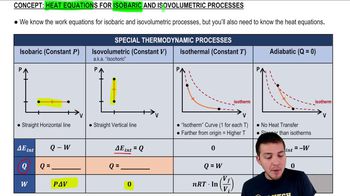
An isobaric process is a thermodynamic process in which the pressure remains constant while the volume and temperature of the gas may change. In such processes, the heat added to the system results in work done by the system as it expands. This concept is crucial for understanding how gases behave under constant pressure conditions, particularly in relation to changes in temperature and entropy.
Video consigliato:
Percorso guidato
06:44
Heat Equations for Isobaric & Isovolumetric Processes

Entropy

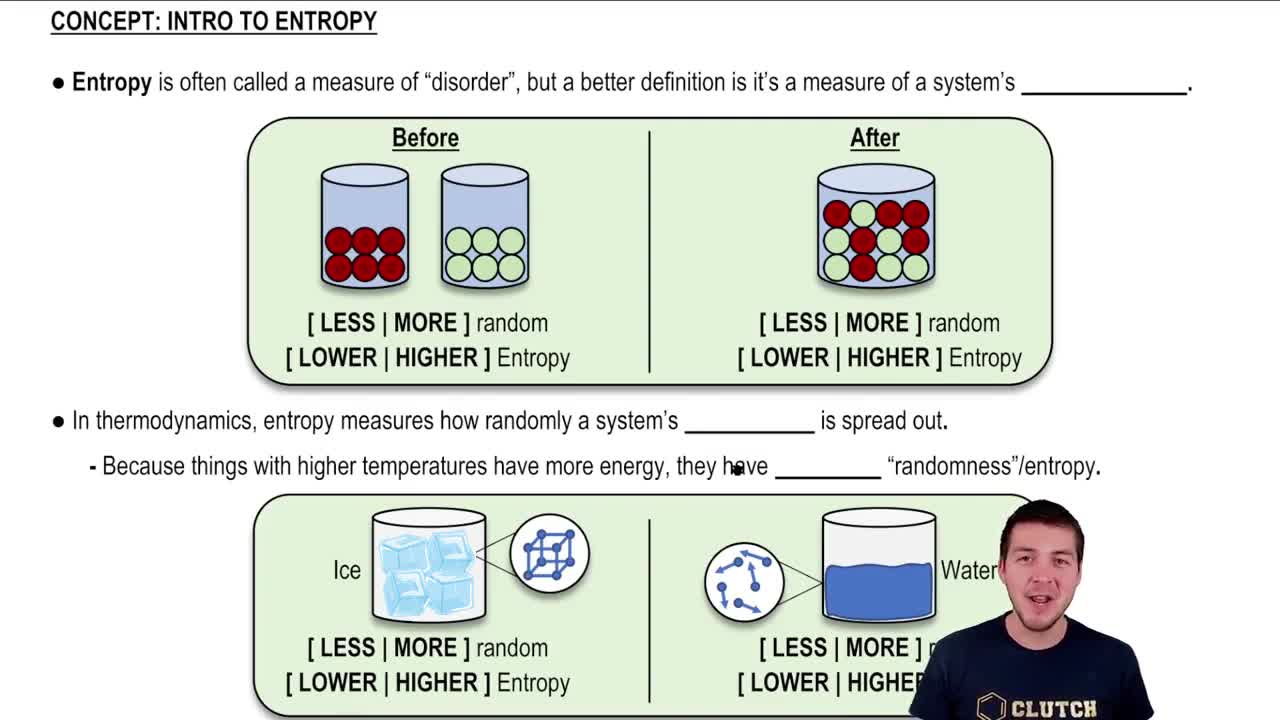
Entropy is a measure of the disorder or randomness in a system, often associated with the amount of energy unavailable for doing work. In thermodynamics, an increase in entropy indicates that the system has absorbed heat and undergone a transformation towards a more disordered state. Understanding entropy is essential for analyzing energy transfers and the direction of thermodynamic processes, especially in relation to temperature changes.
Video consigliato:
Percorso guidato
07:50
Intro to Entropy

Ideal Gas Law

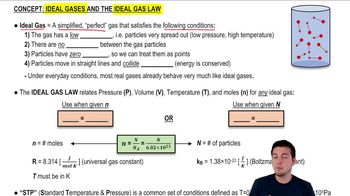
The Ideal Gas Law is a fundamental equation in thermodynamics that relates the pressure, volume, temperature, and number of moles of an ideal gas. It is expressed as PV = nRT, where P is pressure, V is volume, n is the number of moles, R is the ideal gas constant, and T is temperature. This law is vital for calculating the final state of a gas after a thermodynamic process, such as determining the final temperature in the given problem.
Video consigliato:
Percorso guidato
07:21
Ideal Gases and the Ideal Gas Law
Pratica correlata
Domanda del libro di testo

Your calculator can't handle enormous exponents, but we can make sense of large powers of e by converting them to large powers of 10. If we write e = 10α, then eβ = (10α)β = 10αβ. What is the multiplicity of a macrostate with entropy S = 1.0 J/K? Give your answer as a power of 10.

1163
views
Domanda del libro di testo

The pressure inside a tank of neon is 150 atm. The temperature is 25℃. On average, how many atomic diameters does a neon atom move between collisions?

320
views
Domanda del libro di testo

What is the entropy change of the nitrogen if 250 mL of liquid nitrogen boils away and then warms to 20℃ at constant pressure? The density of liquid nitrogen is 810 kg/m3.

1620
views
Domanda del libro di testo

A 75 g ice cube at 0℃ is placed on a very large table at 20℃. You can assume that the temperature of the table does not change. As the ice cube melts and then comes to thermal equilibrium, what are the entropy changes of (a) the water, (b) the table, and (c) the universe?

1645
views
Domanda del libro di testo

Dust particles are ≈ 10 μm in diameter. They are pulverized rock, with ρ ≈ 2500 kg/m³. If you treat dust as an ideal gas, what is the rms speed of a dust particle at 20℃?

1377
views
Domanda del libro di testo

A mad engineer builds a cube, 2.5 m on a side, in which 6.2-cm-diameter rubber balls are constantly sent flying in random directions by vibrating walls. He will award a prize to anyone who can figure out how many balls are in the cube without entering it or taking out any of the balls. You decide to shoot 6.2-cm-diameter plastic balls into the cube, through a small hole, to see how far they get before colliding with a rubber ball. After many shots, you find they travel an average distance of 1.8 m. How many rubber balls do you think are in the cube?

1517
views