
Ch 20: The Micro/Macro Connection
Knight Calc - Physics for Scientists and Engineers 5th Edition
Knight Calc5th EditionPhysics for Scientists and EngineersISBN: 9780137344796Non è quello che usi tu?Cambia libro di testo
Capitolo 20, Problema 38b

Your calculator can't handle enormous exponents, but we can make sense of large powers of e by converting them to large powers of 10. If we write e = 10α, then eβ = (10α)β = 10αβ. What is the multiplicity of a macrostate with entropy S = 1.0 J/K? Give your answer as a power of 10.

Guida verificata passo dopo passo
1
The multiplicity (Ω) of a macrostate is related to its entropy (S) by the formula: S = k_B * ln(Ω), where k_B is the Boltzmann constant (k_B ≈ 1.38 × 10^-23 J/K). Rearrange this equation to solve for Ω: Ω = e^(S / k_B).
To simplify the calculation, note that e can be expressed as a power of 10: e = 10^α, where α ≈ 0.434. This allows us to rewrite e^(S / k_B) as 10^(α * (S / k_B)).
Substitute the given entropy S = 1.0 J/K and the value of k_B into the expression: S / k_B = 1.0 / (1.38 × 10^-23). This gives the exponent for the power of e.
Now, multiply the result of S / k_B by α (0.434) to convert the base e exponent into a base 10 exponent. This gives the final exponent for the power of 10.
Express the multiplicity Ω as 10^(α * (S / k_B)), where the exponent is the value calculated in the previous step. This is the multiplicity of the macrostate as a power of 10.

Risposta video verificata per un problema simile:

Questa soluzione video è stata consigliata dai nostri tutor come utile per risolvere questo problema.
Durata del video:
5m

Concetti chiave

Ecco i concetti essenziali che devi comprendere per rispondere correttamente alla domanda.

Entropy

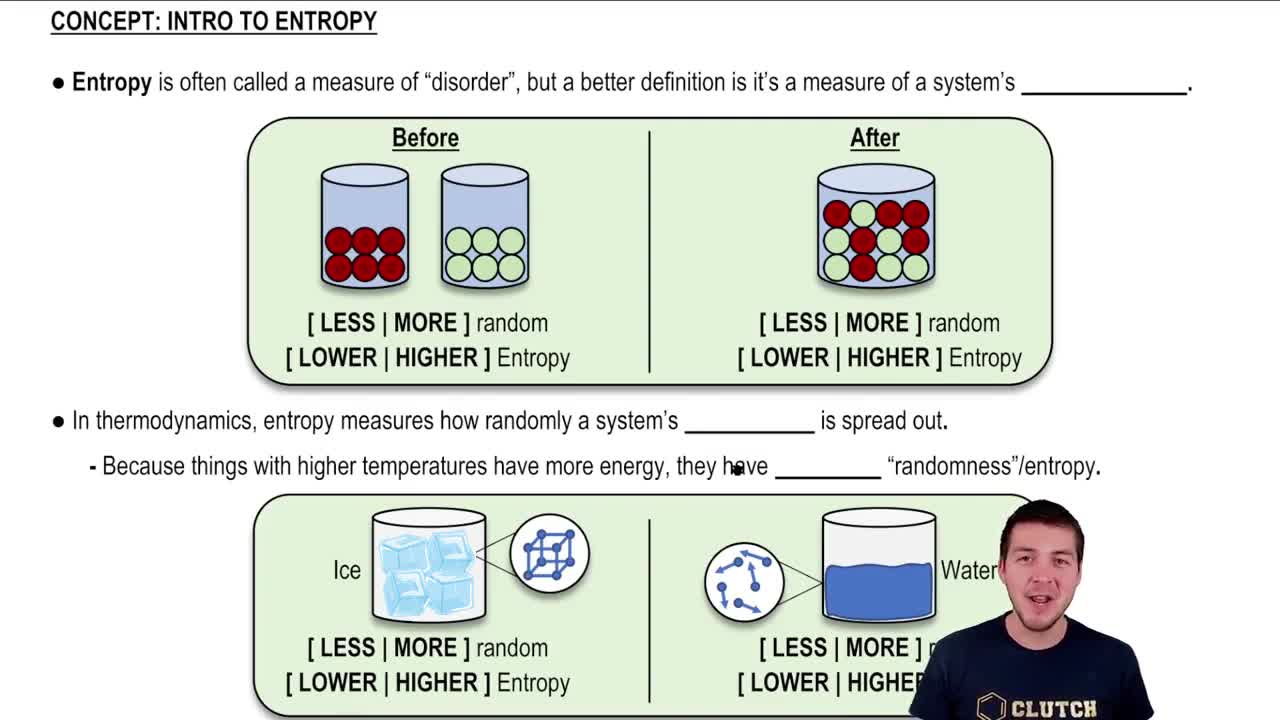
Entropy is a measure of the disorder or randomness in a system, often associated with the number of microscopic configurations that correspond to a macroscopic state. In thermodynamics, higher entropy indicates a greater number of possible arrangements of particles, leading to increased disorder. The relationship between entropy and multiplicity is fundamental, as entropy can be calculated using the formula S = k * ln(Ω), where k is the Boltzmann constant and Ω is the multiplicity.
Video consigliato:
Percorso guidato
07:50
Intro to Entropy

Multiplicity

Multiplicity refers to the number of distinct microscopic states that correspond to a particular macroscopic state of a system. It quantifies how many ways a system can be arranged while still exhibiting the same overall properties. In statistical mechanics, multiplicity is crucial for understanding the relationship between entropy and the likelihood of a system being in a certain state, as higher multiplicity corresponds to higher entropy.
Video consigliato:
Percorso guidato
14:31
Equilibrium with Multiple Supports

Exponential Growth and Logarithms

Exponential growth describes a process where a quantity increases at a rate proportional to its current value, often represented mathematically as e^x or 10^x. Logarithms are the inverse operations of exponentiation, allowing us to express large numbers in a more manageable form. In the context of the question, converting between bases (e and 10) using logarithmic relationships helps simplify calculations involving large powers, making it easier to express multiplicity in terms of powers of 10.
Video consigliato:
Pratica correlata
Domanda del libro di testo

The vibrational modes of molecular nitrogen are 'frozen out' at room temperature but become active at temperatures above ≈1500 K. The temperature in the combustion chamber of a jet engine can reach 2000 K, so an engineering analysis of combustion requires knowing the thermal properties of materials at these temperatures. What is the expected specific heat ratio γ for nitrogen at 2000 K?

2367
views
Domanda del libro di testo

What is the entropy change of the nitrogen if 250 mL of liquid nitrogen boils away and then warms to 20℃ at constant pressure? The density of liquid nitrogen is 810 kg/m3.

1620
views
Domanda del libro di testo

2.0 mol of monatomic gas A initially has 5000 J of thermal energy. It interacts with 3.0 mol of monatomic gas B, which initially has 8000 J of thermal energy. Which gas has the higher initial temperature?

1760
views
Domanda del libro di testo

A 75 g ice cube at 0℃ is placed on a very large table at 20℃. You can assume that the temperature of the table does not change. As the ice cube melts and then comes to thermal equilibrium, what are the entropy changes of (a) the water, (b) the table, and (c) the universe?

1645
views
Domanda del libro di testo

2.0 mol of helium at 280℃ undergo an isobaric process in which the helium entropy increases by 35 J/K. What is the final temperature of the gas?

1870
views
Domanda del libro di testo

The thermal energy of 1.0 mol of a substance is increased by 1.0 J. What is the temperature change if the system is (a) a monatomic gas, (b) a diatomic gas, and (c) a solid?

1781
views