Ch 24: Gauss' Law
Knight Calc - Physics for Scientists and Engineers 5th Edition
Knight Calc5th EditionPhysics for Scientists and EngineersISBN: 9780137344796Non è quello che usi tu?Cambia libro di testo
Capitolo 24, Problema 31

A 10 nC charge is at the center of a 2.0 m x 2.0 m x 2.0 m cube. What is the electric flux through the top surface of the cube?

Guida verificata passo dopo passo
1
Step 1: Recall Gauss's Law, which states that the electric flux (Φ) through a closed surface is given by Φ = Q / ε₀, where Q is the total charge enclosed and ε₀ is the permittivity of free space (ε₀ ≈ 8.85 × 10⁻¹² C²/(N·m²)).
Step 2: Understand that the charge is symmetrically placed at the center of the cube. Due to symmetry, the electric flux is evenly distributed across all six faces of the cube.
Step 3: Calculate the total electric flux through the entire cube using Gauss's Law: Φ_total = Q / ε₀. Substitute Q = 10 nC (10 × 10⁻⁹ C) into the formula.
Step 4: Divide the total electric flux by 6 to find the flux through one face of the cube, since the flux is evenly distributed across all six faces. Use the formula Φ_face = Φ_total / 6.
Step 5: Express the result in terms of the given values and constants, ensuring the units are consistent throughout the calculation. The flux through the top surface of the cube is Φ_face.

Risposta video verificata per un problema simile:

Questa soluzione video è stata consigliata dai nostri tutor come utile per risolvere questo problema.
Durata del video:
1m

Concetti chiave

Ecco i concetti essenziali che devi comprendere per rispondere correttamente alla domanda.

Gauss's Law

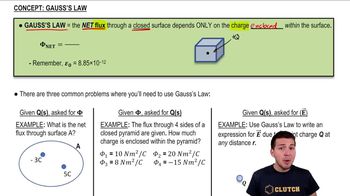
Gauss's Law states that the electric flux through a closed surface is proportional to the charge enclosed within that surface. Mathematically, it is expressed as Φ = Q_enc/ε₀, where Φ is the electric flux, Q_enc is the enclosed charge, and ε₀ is the permittivity of free space. This principle is fundamental in electrostatics and allows for the calculation of electric fields in symmetric charge distributions.
Video consigliato:

Electric Flux

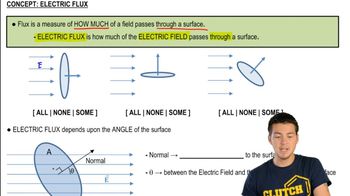
Electric flux is a measure of the quantity of electric field lines passing through a given surface area. It is defined as the dot product of the electric field vector and the area vector, integrated over the surface. The unit of electric flux is the volt-meter (V·m), and it helps in understanding how electric fields interact with surfaces, particularly in the context of Gauss's Law.
Video consigliato:

Symmetry in Charge Distribution

In problems involving electric fields and flux, symmetry plays a crucial role in simplifying calculations. For a uniformly distributed charge, such as a point charge at the center of a cube, the electric field is symmetric and uniform across the surfaces of the cube. This symmetry allows us to deduce that the electric flux through each face of the cube is equal, facilitating the calculation of the total flux through any specific surface.
Video consigliato:
Percorso guidato
12:39
Solving Symmetric Launch Problems