Ch 24: Gauss' Law
Knight Calc - Physics for Scientists and Engineers 5th Edition
Knight Calc5th EditionPhysics for Scientists and EngineersISBN: 9780137344796Non è quello che usi tu?Cambia libro di testo
Capitolo 24, Problema 32

Charges q1=−4Qq_1 = -4Q and q2=+2Qq_2 = +2Q are located at 𝓍=−a𝓍 = -a and 𝓍=+a𝓍 = +a, respectively. What is the net electric flux through a sphere of radius 2a2a centered (a) at the origin and (b) at 𝓍=2a𝓍 = 2a?

Guida verificata passo dopo passo
1
Step 1: Recall Gauss's Law, which states that the net electric flux (Φ) through a closed surface is proportional to the total charge enclosed within the surface. Mathematically, it is expressed as: Φ = (qenclosed)/(ε0), where qenclosed is the total charge enclosed by the surface and ε0 is the permittivity of free space.
Step 2: For part (a), the sphere of radius 2a is centered at the origin. Both charges q₁ = -4Q (at 𝓍 = -a) and q₂ = +2Q (at 𝓍 = +a) are inside the sphere. Calculate the total charge enclosed by summing the charges: qenclosed = q₁ + q₂ = -4Q + 2Q. Substitute this value into Gauss's Law to find the net electric flux.
Step 3: For part (b), the sphere of radius 2a is centered at 𝓍 = 2a. Determine whether the charges q₁ and q₂ are inside or outside the sphere. Note that q₁ is located at 𝓍 = -a, which is outside the sphere, and q₂ is located at 𝓍 = +a, which is also outside the sphere. Since no charges are enclosed by the sphere, qenclosed = 0. Substitute this value into Gauss's Law to find the net electric flux.
Step 4: For part (a), simplify the expression for the net electric flux using the value of qenclosed calculated in Step 2. The flux will depend on the total enclosed charge and the permittivity of free space, ε0. Write the final expression for the flux.
Step 5: For part (b), since qenclosed = 0, the net electric flux through the sphere is zero. This result follows directly from Gauss's Law, as no charge is enclosed within the sphere.

Risposta video verificata per un problema simile:

Questa soluzione video è stata consigliata dai nostri tutor come utile per risolvere questo problema.

Concetti chiave

Ecco i concetti essenziali che devi comprendere per rispondere correttamente alla domanda.

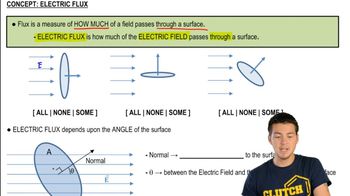
Electric Flux

Electric flux is a measure of the electric field passing through a given area. It is defined mathematically as the product of the electric field and the area through which it passes, taking into account the angle between the field lines and the normal to the surface. The unit of electric flux is the volt-meter (V·m) or equivalently, the newton-meter squared per coulomb (N·m²/C).
Video consigliato:

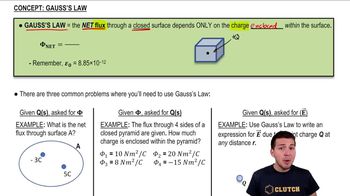
Gauss's Law

Gauss's Law states that the total electric flux through a closed surface is proportional to the enclosed electric charge. Mathematically, it is expressed as Φ_E = Q_enc/ε₀, where Φ_E is the electric flux, Q_enc is the total charge enclosed by the surface, and ε₀ is the permittivity of free space. This law is fundamental in electrostatics and simplifies the calculation of electric fields for symmetric charge distributions.
Video consigliato:

Charge Distribution

Charge distribution refers to how electric charge is spread out in space. In this problem, we have two point charges located at specific positions, which influence the electric field and flux in their vicinity. Understanding the nature of these charges (positive or negative) and their locations is crucial for applying Gauss's Law to determine the net electric flux through the specified surfaces.
Video consigliato:
Percorso guidato
04:03
Probability Distribution Graph