Two positive point charges are 5.0 cm apart. If the electric potential energy is 72 μJ, what is the magnitude of the force between the two charges?
Ch 25: The Electric Potential
Knight Calc5th EditionPhysics for Scientists and EngineersISBN: 9780137344796Non è quello che usi tu?Cambia libro di testo
Capitolo 25, Problema 10a
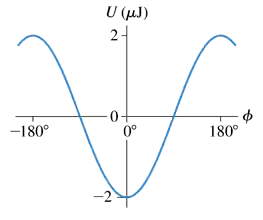
FIGURE EX25.10 shows the potential energy of an electric dipole. Consider a dipole that oscillates between ±60°. What is the dipole's mechanical energy?

Guida verificata passo dopo passo1
Step 1: Understand the problem. The mechanical energy of the dipole is the sum of its potential energy and kinetic energy. Since the dipole oscillates between ±60°, its mechanical energy corresponds to the maximum potential energy at these angles.
Step 2: Analyze the graph. The graph shows the potential energy U (in μJ) as a function of the angle φ (in degrees). At ±60°, locate the corresponding potential energy value on the graph. This will be the maximum potential energy of the dipole during its oscillation.
Step 3: Recall that mechanical energy is conserved in oscillatory motion. The mechanical energy remains constant and is equal to the maximum potential energy when the dipole is at its turning points (±60°).
Step 4: Use the graph to determine the potential energy at ±60°. From the graph, visually identify the value of U at φ = ±60°. This value represents the mechanical energy of the dipole.
Step 5: Conclude that the mechanical energy of the dipole is equal to the potential energy at ±60°, as there is no kinetic energy at the turning points. Use the graph to confirm the numerical value of U at these angles.

Risposta video verificata per un problema simile:
Questa soluzione video è stata consigliata dai nostri tutor come utile per risolvere questo problema.
Concetti chiave
Ecco i concetti essenziali che devi comprendere per rispondere correttamente alla domanda.
Electric Dipole
An electric dipole consists of two equal and opposite charges separated by a distance. It creates an electric field and experiences a torque when placed in an external electric field. The orientation of the dipole relative to the field affects its potential energy, which is minimized when aligned with the field.
Video consigliato:
Percorso guidato
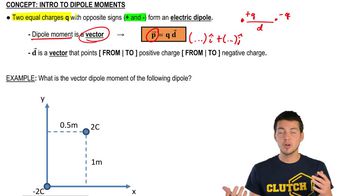
Intro To Dipole Moment
Potential Energy of a Dipole
The potential energy (U) of an electric dipole in an electric field is given by the equation U = -p·E·cos(θ), where p is the dipole moment, E is the electric field strength, and θ is the angle between the dipole moment and the field. This energy varies with the angle, reaching a maximum when the dipole is perpendicular to the field and a minimum when aligned with it.
Video consigliato:
Percorso guidato
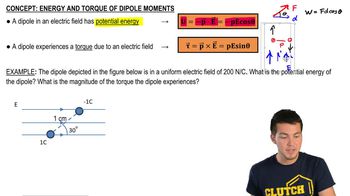
Energy & Torque of Dipole Moments
Mechanical Energy in Oscillations
Mechanical energy in oscillating systems, such as a dipole oscillating between ±60°, is the sum of kinetic and potential energy. As the dipole moves, its potential energy changes while kinetic energy varies inversely. The total mechanical energy remains constant if no external work is done, allowing the dipole to oscillate between its maximum and minimum potential energy states.
Video consigliato:
Percorso guidato
Conservation Of Mechanical Energy
Pratica correlata
Domanda del libro di testo
2165
views
Domanda del libro di testo
Three charged particles are placed at the corners of an equilateral triangle that has edge length 2.0 cm. One particle has charge +3.0 nC and a second has charge +6.0 nC. What is the third charge if the electric potential energy of the three charged particles is zero?
300
views
Domanda del libro di testo
What is the speed of an electron that has been accelerated from rest through a potential difference of 1000 V?
244
views
Domanda del libro di testo
What is the electric potential energy of the group of charges in FIGURE EX25.5?
526
views
Domanda del libro di testo
What potential difference is needed to accelerate an electron from rest to a speed of 2.0×10⁶ m/s?
275
views
Domanda del libro di testo
A proton with an initial speed of 800,000 m/s is brought to rest by an electric field. What was the potential difference that stopped the proton?
166
views