FIGURE EX25.10 shows the potential energy of an electric dipole. Consider a dipole that oscillates between ±60°. What is the dipole's mechanical energy?
Ch 25: The Electric Potential
Knight Calc5th EditionPhysics for Scientists and EngineersISBN: 9780137344796Non è quello che usi tu?Cambia libro di testo
Capitolo 25, Problema 8
Three charged particles are placed at the corners of an equilateral triangle that has edge length 2.0 cm. One particle has charge +3.0 nC and a second has charge +6.0 nC. What is the third charge if the electric potential energy of the three charged particles is zero?
Guida verificata passo dopo passo1
Understand the problem: The electric potential energy of a system of three charges is given by the sum of the potential energy contributions from each pair of charges. The goal is to find the value of the third charge such that the total electric potential energy of the system is zero.
Write the formula for the electric potential energy between two charges: \( U = \frac{k \cdot q_1 \cdot q_2}{r} \), where \( k \) is Coulomb's constant (\( 8.99 \times 10^9 \ \text{N·m}^2/\text{C}^2 \)), \( q_1 \) and \( q_2 \) are the charges, and \( r \) is the distance between them.
Set up the total electric potential energy equation for the system: \( U_{total} = U_{12} + U_{13} + U_{23} \), where \( U_{12} \), \( U_{13} \), and \( U_{23} \) are the potential energies between the respective pairs of charges. Substitute \( U_{12} = \frac{k \cdot (3.0 \times 10^{-9}) \cdot (6.0 \times 10^{-9})}{0.02} \), \( U_{13} = \frac{k \cdot (3.0 \times 10^{-9}) \cdot q_3}{0.02} \), and \( U_{23} = \frac{k \cdot (6.0 \times 10^{-9}) \cdot q_3}{0.02} \).
Set \( U_{total} = 0 \) and solve for \( q_3 \): Combine the terms into a single equation: \( \frac{k \cdot (3.0 \times 10^{-9}) \cdot (6.0 \times 10^{-9})}{0.02} + \frac{k \cdot (3.0 \times 10^{-9}) \cdot q_3}{0.02} + \frac{k \cdot (6.0 \times 10^{-9}) \cdot q_3}{0.02} = 0 \). Factor out common terms and simplify to isolate \( q_3 \).
Solve for \( q_3 \): Rearrange the equation to find \( q_3 \) in terms of the known charges and constants. This will give the value of the third charge that makes the total electric potential energy zero.

Risposta video verificata per un problema simile:
Questa soluzione video è stata consigliata dai nostri tutor come utile per risolvere questo problema.
Concetti chiave
Ecco i concetti essenziali che devi comprendere per rispondere correttamente alla domanda.
Electric Potential Energy
Electric potential energy is the energy a charged particle possesses due to its position in an electric field. It is influenced by the charges involved and the distances between them. In this scenario, the total electric potential energy of the system must equal zero, which means the contributions from all three charges must balance each other out.
Video consigliato:
Percorso guidato
Electric Potential Energy
Coulomb's Law
Coulomb's Law describes the force between two point charges. It states that the force is directly proportional to the product of the magnitudes of the charges and inversely proportional to the square of the distance between them. This law is essential for calculating the interactions between the charged particles in the triangle and determining the conditions for zero potential energy.
Video consigliato:
Percorso guidato
Coulomb's Law
Equilateral Triangle Geometry
An equilateral triangle has all sides of equal length and all angles measuring 60 degrees. This symmetry simplifies calculations involving the distances between the charges. In this problem, knowing the geometry allows us to apply the principles of electric potential energy and Coulomb's Law effectively, as the distances between the charges are uniform.
Video consigliato:
Percorso guidato
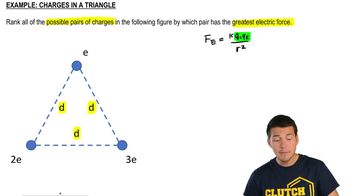
Charges In A Triangle (Rank Force Pairs)
Pratica correlata
Domanda del libro di testo
340
views
Domanda del libro di testo
Two positive point charges are 5.0 cm apart. If the electric potential energy is 72 μJ, what is the magnitude of the force between the two charges?
2165
views
Domanda del libro di testo
What is the speed of an electron that has been accelerated from rest through a potential difference of 1000 V?
244
views
Domanda del libro di testo
What is the electric potential energy of the group of charges in FIGURE EX25.5?
526
views
Domanda del libro di testo
An electron is released from rest at the center of a parallel-plate capacitor that has a 1.0 mm spacing. The electron then strikes one of the plates with a speed of 1.5×10⁶ m/s. What is the electric field strength inside the capacitor?
3045
views
Domanda del libro di testo
What potential difference is needed to accelerate an electron from rest to a speed of 2.0×10⁶ m/s?
275
views