Ch 25: The Electric Potential
Knight Calc - Physics for Scientists and Engineers 5th Edition
Knight Calc5th EditionPhysics for Scientists and EngineersISBN: 9780137344796Non è quello che usi tu?Cambia libro di testo
Capitolo 25, Problema 11

What is the speed of an electron that has been accelerated from rest through a potential difference of 1000 V?

Guida verificata passo dopo passo
1
Start by understanding the relationship between the potential difference and the kinetic energy gained by the electron. The work done on the electron by the electric field is equal to the change in its kinetic energy. This can be expressed as: qV = \(\frac{1}{2}\)mv^2, where q is the charge of the electron, V is the potential difference, m is the mass of the electron, and v is the speed of the electron.
Rearrange the equation to solve for the speed v: v = \(\sqrt{\frac{2qV}{m}\)}.
Substitute the known values into the equation. The charge of an electron is q = 1.6 \(\times\) 10^{-19} \(\text{ C}\), the mass of an electron is m = 9.11 \(\times\) 10^{-31} \(\text{ kg}\), and the potential difference is V = 1000 \(\text{ V}\).
Plug these values into the formula: v = \(\sqrt{\frac{2(1.6 \times 10^{-19}\))(1000)}{9.11 \(\times\) 10^{-31}}}.
Simplify the expression under the square root to calculate the speed of the electron. Ensure that the units are consistent and verify the result for correctness.

Risposta video verificata per un problema simile:

Questa soluzione video è stata consigliata dai nostri tutor come utile per risolvere questo problema.

Concetti chiave

Ecco i concetti essenziali che devi comprendere per rispondere correttamente alla domanda.

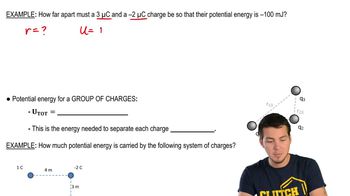
Electric Potential Energy

Electric potential energy is the energy a charged particle possesses due to its position in an electric field. When an electron is accelerated through a potential difference, it gains kinetic energy equal to the work done on it by the electric field, which can be calculated using the formula: ΔU = qV, where q is the charge of the electron and V is the potential difference.
Video consigliato:
Percorso guidato
07:51
Electric Potential Energy

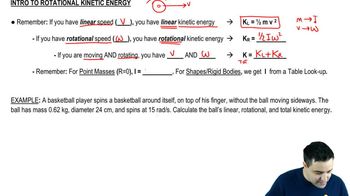
Kinetic Energy

Kinetic energy is the energy of an object due to its motion, expressed mathematically as KE = 1/2 mv², where m is the mass and v is the velocity of the object. In the context of an electron accelerated through a potential difference, the kinetic energy gained by the electron can be equated to the electric potential energy it acquires, allowing us to solve for its speed.
Video consigliato:
Percorso guidato
06:07
Intro to Rotational Kinetic Energy

Charge of an Electron

The charge of an electron is a fundamental physical constant, approximately -1.6 x 10^-19 coulombs. This negative charge is crucial in calculations involving electric fields and potential differences, as it determines the direction of the force acting on the electron when it is subjected to an electric field, ultimately influencing its acceleration and resulting speed.
Video consigliato:
Percorso guidato
04:32
Electrons In Water (Using Density)