A 2.0-cm-diameter parallel-plate capacitor with a spacing of 0.50 mm is charged to 200 V. What are (a) the total energy stored in the electric field and (b) the energy density?
Ch 26: Potential and Field
Knight Calc5th EditionPhysics for Scientists and EngineersISBN: 9780137344796Non è quello che usi tu?Cambia libro di testo
Capitolo 26, Problema 25
A 6 μF capacitor, a 10 μF capacitor, and a 16 μF capacitor are connected in series. What is their equivalent capacitance?
Guida verificata passo dopo passo1
When capacitors are connected in series, the reciprocal of the equivalent capacitance is the sum of the reciprocals of the individual capacitances. The formula is: .
Substitute the given capacitances into the formula: , where the capacitances are in microfarads (μF).
Find the least common denominator (LCD) of the fractions to simplify the addition. The LCD for 6, 10, and 16 is 240. Rewrite each fraction with this denominator: .
Add the numerators of the fractions: . This gives the reciprocal of the equivalent capacitance.
Finally, take the reciprocal of the result to find the equivalent capacitance: . Simplify the fraction if necessary, and the result will be in microfarads (μF).

Risposta video verificata per un problema simile:
Questa soluzione video è stata consigliata dai nostri tutor come utile per risolvere questo problema.
Concetti chiave
Ecco i concetti essenziali che devi comprendere per rispondere correttamente alla domanda.
Capacitance
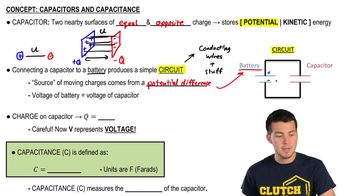
Capacitance is the ability of a capacitor to store electrical charge per unit voltage. It is measured in farads (F) and is defined as the ratio of the electric charge (Q) stored on one plate of the capacitor to the voltage (V) across the plates. In practical terms, a higher capacitance means a capacitor can store more charge at a given voltage.
Video consigliato:
Percorso guidato
Capacitors & Capacitance (Intro)
Capacitors in Series
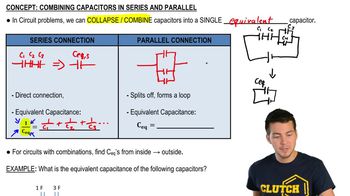
When capacitors are connected in series, the total or equivalent capacitance (C_eq) is less than the smallest individual capacitor in the series. The formula for calculating the equivalent capacitance of capacitors in series is given by 1/C_eq = 1/C1 + 1/C2 + 1/C3, where C1, C2, and C3 are the capacitances of the individual capacitors. This configuration results in a reduced ability to store charge compared to individual capacitors.
Video consigliato:
Percorso guidato
Combining Capacitors in Series & Parallel
Equivalent Capacitance
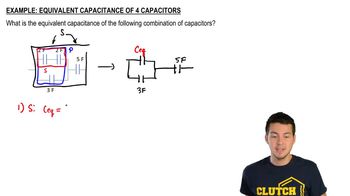
Equivalent capacitance is a single capacitance value that represents the combined effect of multiple capacitors in a circuit. It simplifies circuit analysis by allowing us to treat a group of capacitors as one capacitor. For series connections, the equivalent capacitance is calculated using the reciprocal formula, while for parallel connections, it is the sum of the individual capacitances.
Video consigliato:
Percorso guidato
Find Equivalent Capacitance #1
Pratica correlata
Domanda del libro di testo
173
views
Domanda del libro di testo
What is the capacitance of the two metal spheres shown in FIGURE EX26.22?
230
views
Domanda del libro di testo
What is the equivalent capacitance of the three capacitors in FIGURE EX26.27?
1757
views
Domanda del libro di testo
A switch that connects a battery to a 10 μF capacitor is closed. Several seconds later you find that the capacitor plates are charged to ±30 μC. What is the emf of the battery?
1661
views
Domanda del libro di testo
You need a capacitance of 50 μF, but you don't happen to have a 50 μF capacitor. You do have a 75 μF capacitor. What additional capacitor do you need to produce a total capacitance of 50 μF? Should you join the two capacitors in parallel or in series?
169
views
Domanda del libro di testo
Two 3.0-cm-diameter aluminum electrodes are spaced 0.50 mm apart. The electrodes are connected to a 100 V battery. What is the magnitude of the charge on each electrode?
1251
views