Ch 26: Potential and Field
Knight Calc - Physics for Scientists and Engineers 5th Edition
Knight Calc5th EditionPhysics for Scientists and EngineersISBN: 9780137344796Non è quello che usi tu?Cambia libro di testo
Capitolo 26, Problema 24

A switch that connects a battery to a 10 μF capacitor is closed. Several seconds later you find that the capacitor plates are charged to ±30 μC. What is the emf of the battery?

Guida verificata passo dopo passo
1
Step 1: Understand the relationship between charge (Q), capacitance (C), and voltage (V) for a capacitor. The formula is given by: Q=CV, where Q is the charge on the capacitor, C is the capacitance, and V is the voltage across the capacitor.
Step 2: Identify the given values in the problem. The capacitance of the capacitor is 10 μF = 10 × 10-6 F, and the charge on the capacitor is 30 μC = 30 × 10-6 C. The voltage across the capacitor is equal to the emf of the battery since the capacitor is fully charged.
Step 3: Rearrange the formula Q=CV to solve for the voltage (V). The rearranged formula is: V=Q/C.
Step 4: Substitute the given values into the formula. Use Q = 30 × 10-6 C and C = 10 × 10-6 F to calculate the voltage.
Step 5: The calculated voltage (V) will represent the emf of the battery. Ensure the units are consistent and verify the calculation process to confirm the result.

Risposta video verificata per un problema simile:

Questa soluzione video è stata consigliata dai nostri tutor come utile per risolvere questo problema.

Concetti chiave

Ecco i concetti essenziali che devi comprendere per rispondere correttamente alla domanda.

Capacitance

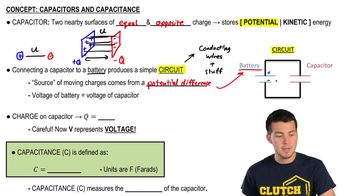
Capacitance is the ability of a capacitor to store charge per unit voltage, measured in farads (F). It is defined by the formula C = Q/V, where C is capacitance, Q is the charge stored, and V is the voltage across the capacitor. In this scenario, the capacitor has a capacitance of 10 μF, which indicates how much charge it can hold at a given voltage.
Video consigliato:
Percorso guidato
08:02
Capacitors & Capacitance (Intro)

Charge and Voltage Relationship

The relationship between charge (Q), capacitance (C), and voltage (V) is fundamental in understanding capacitors. When a capacitor is charged, the voltage across its plates is directly proportional to the charge stored. This relationship can be expressed as V = Q/C, allowing us to calculate the voltage if we know the charge and capacitance.
Video consigliato:
Percorso guidato
03:43
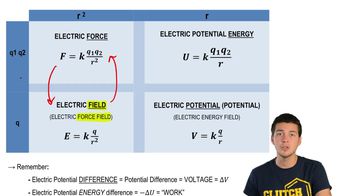
Relationships Between Force, Field, Energy, Potential

Electromotive Force (emf)

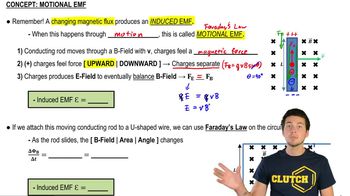
Electromotive force (emf) is the voltage generated by a battery or other source when no current is flowing. It represents the potential difference that drives current through a circuit. In this case, the emf of the battery can be determined by the voltage across the capacitor once it is fully charged, which can be calculated using the charge and capacitance values provided.
Video consigliato: