Two 3.0-cm-diameter aluminum electrodes are spaced 0.50 mm apart. The electrodes are connected to a 100 V battery. What is the capacitance?
Ch 26: Potential and Field
Knight Calc5th EditionPhysics for Scientists and EngineersISBN: 9780137344796Non è quello che usi tu?Cambia libro di testo
Capitolo 26, Problema 22
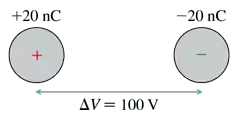
What is the capacitance of the two metal spheres shown in FIGURE EX26.22?

Guida verificata passo dopo passo1
Step 1: Understand the concept of capacitance. Capacitance (C) is defined as the ratio of the charge (Q) on one conductor to the potential difference (ΔV) between the two conductors. The formula is: .
Step 2: Identify the given values from the figure. The charge on one sphere is C (20 nC), and the potential difference between the spheres is V.
Step 3: Substitute the values into the capacitance formula. Using , replace Q with C and ΔV with V.
Step 4: Perform the division to calculate the capacitance. Divide the charge by the potential difference: . This will give the capacitance in Farads (F).
Step 5: Interpret the result. The capacitance value obtained will be in Farads, which is the SI unit for capacitance. This value represents the ability of the two spheres to store charge per unit potential difference.

Risposta video verificata per un problema simile:
Questa soluzione video è stata consigliata dai nostri tutor come utile per risolvere questo problema.
Concetti chiave
Ecco i concetti essenziali che devi comprendere per rispondere correttamente alla domanda.
Capacitance
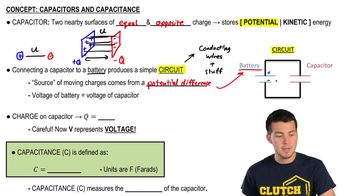
Capacitance is the ability of a system to store electric charge per unit voltage. It is defined as the ratio of the charge (Q) stored on the conductors to the potential difference (V) between them, expressed as C = Q/V. In the case of two metal spheres, the capacitance can be calculated based on their charges and the potential difference between them.
Video consigliato:
Percorso guidato
Capacitors & Capacitance (Intro)
Electric Potential Difference
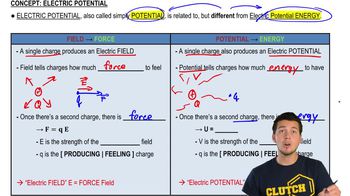
Electric potential difference, or voltage (ΔV), is the work done per unit charge in moving a charge between two points in an electric field. It is a measure of the energy difference that drives the flow of electric charge. In this scenario, the potential difference of 100 V indicates the energy required to move a charge between the two spheres with opposite charges.
Video consigliato:
Percorso guidato
Electric Potential
Charge Distribution
Charge distribution refers to how electric charge is spread over a conductor's surface. In the case of the two spheres, one has a positive charge of +20 nC and the other a negative charge of -20 nC. This distribution affects the electric field between the spheres and is crucial for calculating the capacitance, as it determines how much charge can be stored for a given potential difference.
Video consigliato:
Percorso guidato
Probability Distribution Graph
Pratica correlata
Domanda del libro di testo
1517
views
Domanda del libro di testo
Light from the sun allows a solar cell to move electrons from the positive to the negative terminal, doing 2.4×10⁻¹⁹ J of work per electron. What is the emf of this solar cell?
1247
views
Domanda del libro di testo
A 6 μF capacitor, a 10 μF capacitor, and a 16 μF capacitor are connected in series. What is their equivalent capacitance?
283
views
Domanda del libro di testo
What is the equivalent capacitance of the three capacitors in FIGURE EX26.27?
1757
views
Domanda del libro di testo
A switch that connects a battery to a 10 μF capacitor is closed. Several seconds later you find that the capacitor plates are charged to ±30 μC. What is the emf of the battery?
1661
views
Domanda del libro di testo
Two 3.0-cm-diameter aluminum electrodes are spaced 0.50 mm apart. The electrodes are connected to a 100 V battery. What is the magnitude of the charge on each electrode?
1251
views