The electric field inside a 30-cm-long copper wire is 5.0 mV/m. What is the potential difference between the ends of the wire?
Ch 27: Current and Resistance
Knight Calc5th EditionPhysics for Scientists and EngineersISBN: 9780137344796Non è quello che usi tu?Cambia libro di testo
Capitolo 27, Problema 26b
A 1.5 V battery provides 0.50 A of current. How much work does the charge escalator do to lift 1.0 C of charge?
Guida verificata passo dopo passo1
Understand the relationship between voltage, work, and charge. The work done by the battery on a charge is given by the formula: , where is the work, is the charge, and is the voltage.
Identify the given values in the problem: the voltage of the battery is V, and the charge to be lifted is C.
Substitute the given values into the formula: .
Simplify the expression to calculate the work done. This will give the amount of energy (in joules) required to lift the charge.
Conclude that the work done by the charge escalator is directly proportional to the product of the charge and the voltage, as shown in the formula.

Risposta video verificata per un problema simile:
Questa soluzione video è stata consigliata dai nostri tutor come utile per risolvere questo problema.
Durata del video:
2mConcetti chiave
Ecco i concetti essenziali che devi comprendere per rispondere correttamente alla domanda.
Voltage
Voltage, measured in volts (V), is the electric potential difference between two points in a circuit. It represents the energy per unit charge available to move charges through a circuit. In this question, the 1.5 V battery indicates that each coulomb of charge has 1.5 joules of energy available to do work.
Video consigliato:
Percorso guidato
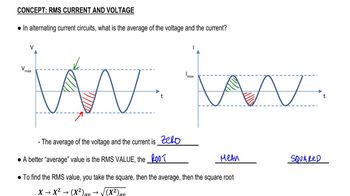
RMS Current and Voltage
Current
Current, measured in amperes (A), is the flow of electric charge in a circuit. It quantifies how much charge passes through a point in the circuit per unit time. In this scenario, a current of 0.50 A means that 0.50 coulombs of charge flow through the circuit every second, which is essential for calculating the work done on the charge.
Video consigliato:
Percorso guidato
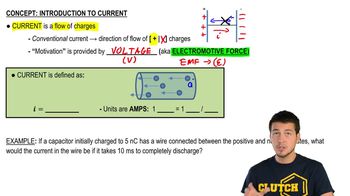
Intro to Current
Work Done by Electric Charge
The work done by an electric charge when moving through a potential difference is calculated using the formula W = Q × V, where W is work in joules, Q is charge in coulombs, and V is voltage in volts. In this case, lifting 1.0 C of charge through a 1.5 V potential difference results in 1.5 joules of work done, illustrating the relationship between charge, voltage, and work.
Video consigliato:
Percorso guidato
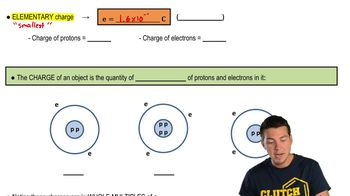
Electric Charge
Pratica correlata
Domanda del libro di testo
181
views
Domanda del libro di testo
How long must a 0.60-mm-diameter aluminum wire be to have a 0.50 A current when connected to the terminals of a 1.5 V flashlight battery?
49
views
Domanda del libro di testo
A hollow copper sphere has inner radius 1.0 cm and outer radius 2.5 cm. A 5.0 A current flows radially outward from the inner surface to the outer surface. What is the electric field strength at r=2.0 cm?
1848
views
Domanda del libro di testo
A 1.5 V battery provides 0.50 A of current. At what rate (C/s) is charge lifted by the charge escalator?
66
views
Domanda del libro di testo
A 0.0075 V/m electric field creates a 3.9 mA current in a 1.0-mm-diameter wire. What material is the wire made of?
73
views
Domanda del libro di testo
An engineer cuts a 1.0-m-long, 0.33-mm-diameter piece of wire, connects it across a 1.5 V battery, and finds that the current in the wire is 8.0 A. Of what material is the wire made?
367
views