A 1.5 V battery provides 0.50 A of current. How much work does the charge escalator do to lift 1.0 C of charge?
Ch 27: Current and Resistance
Knight Calc5th EditionPhysics for Scientists and EngineersISBN: 9780137344796Non è quello che usi tu?Cambia libro di testo
Capitolo 27, Problema 27
An engineer cuts a 1.0-m-long, 0.33-mm-diameter piece of wire, connects it across a 1.5 V battery, and finds that the current in the wire is 8.0 A. Of what material is the wire made?
Guida verificata passo dopo passo1
Determine the resistivity of the material using Ohm's Law and the formula for resistance. Start with Ohm's Law: \( V = IR \), where \( V \) is the voltage, \( I \) is the current, and \( R \) is the resistance. Rearrange to find \( R \): \( R = \frac{V}{I} \). Substitute \( V = 1.5 \ \text{V} \) and \( I = 8.0 \ \text{A} \) to calculate \( R \).
Use the formula for resistance in terms of resistivity: \( R = \rho \frac{L}{A} \), where \( \rho \) is the resistivity, \( L \) is the length of the wire, and \( A \) is the cross-sectional area. Rearrange to solve for \( \rho \): \( \rho = R \frac{A}{L} \).
Calculate the cross-sectional area \( A \) of the wire using the formula for the area of a circle: \( A = \pi r^2 \), where \( r \) is the radius of the wire. The diameter is given as \( 0.33 \ \text{mm} \), so \( r = \frac{0.33}{2} \ \text{mm} \). Convert this to meters before substituting into the formula.
Substitute the values for \( R \), \( A \), and \( L \) into the formula for \( \rho \) to calculate the resistivity of the material. \( L \) is given as \( 1.0 \ \text{m} \).
Compare the calculated resistivity \( \rho \) with known resistivity values for various materials (e.g., copper, aluminum, etc.) to identify the material of the wire.

Risposta video verificata per un problema simile:
Questa soluzione video è stata consigliata dai nostri tutor come utile per risolvere questo problema.
Concetti chiave
Ecco i concetti essenziali che devi comprendere per rispondere correttamente alla domanda.
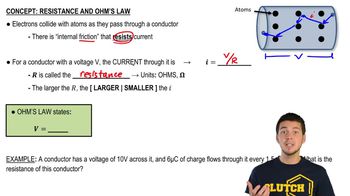
Ohm's Law
Ohm's Law states that the current (I) flowing through a conductor between two points is directly proportional to the voltage (V) across the two points and inversely proportional to the resistance (R) of the conductor. This relationship is expressed mathematically as V = I * R. Understanding this law is crucial for analyzing electrical circuits and determining the properties of materials based on their response to applied voltage.
Video consigliato:
Percorso guidato
Resistance and Ohm's Law
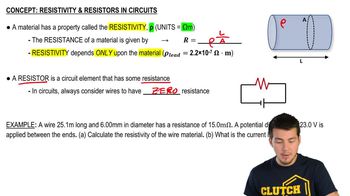
Resistivity
Resistivity is a material property that quantifies how strongly a given material opposes the flow of electric current. It is denoted by the symbol ρ (rho) and is measured in ohm-meters (Ω·m). The resistivity of a material, combined with its dimensions, allows for the calculation of resistance using the formula R = ρ * (L/A), where L is the length and A is the cross-sectional area of the wire. This concept is essential for identifying the material based on the measured current and voltage.
Video consigliato:
Percorso guidato
Resistivity & Resistors in Circuits
Cross-sectional Area
The cross-sectional area of a wire is the area of its circular end face, which affects its resistance and current-carrying capacity. It is calculated using the formula A = π * (d/2)², where d is the diameter of the wire. A larger cross-sectional area results in lower resistance, allowing more current to flow for a given voltage. Understanding this concept is vital for determining how the wire's dimensions influence its electrical properties.
Video consigliato:
Percorso guidato
Calculating the Vector (Cross) Product Using Components
Pratica correlata
Domanda del libro di testo
1523
views
Domanda del libro di testo
The electric field inside a 30-cm-long copper wire is 5.0 mV/m. What is the potential difference between the ends of the wire?
181
views
Domanda del libro di testo
How long must a 0.60-mm-diameter aluminum wire be to have a 0.50 A current when connected to the terminals of a 1.5 V flashlight battery?
49
views
Domanda del libro di testo
FIGURE EX27.35 is a current-versus-potential-difference graph for a material. What is the material's resistance?
64
views
Domanda del libro di testo
A hollow copper sphere has inner radius 1.0 cm and outer radius 2.5 cm. A 5.0 A current flows radially outward from the inner surface to the outer surface. What is the electric field strength at r=2.0 cm?
1848
views
Domanda del libro di testo
A 1.5 V battery provides 0.50 A of current. At what rate (C/s) is charge lifted by the charge escalator?
66
views