Ch 28: Fundamentals of Circuits
Knight Calc - Physics for Scientists and Engineers 5th Edition
Knight Calc5th EditionPhysics for Scientists and EngineersISBN: 9780137344796Non è quello che usi tu?Cambia libro di testo
Capitolo 28, Problema 30

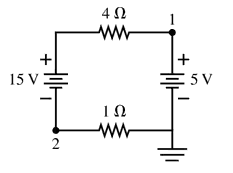
In FIGURE EX28.30, what is the value of the potential at points 1 and 2?
Circuit diagram showing resistors and voltage sources, with points labeled 1 and 2 for potential measurement.

Guida verificata passo dopo passo
1
Step 1: Analyze the circuit diagram. The circuit consists of two batteries (15 V and 5 V), two resistors (4 Ω and 1 Ω), and two points (1 and 2) where the potential needs to be calculated. The circuit is a closed loop, and Kirchhoff's Voltage Law (KVL) will be applied.
Step 2: Apply Kirchhoff's Voltage Law (KVL) to the loop. KVL states that the sum of the potential differences (voltage drops and rises) around any closed loop is zero. Write the equation for the loop considering the direction of current flow and the polarity of the batteries.
Step 3: Calculate the current in the circuit. Use Ohm's Law, \( V = IR \), to find the current. The total resistance in the circuit is the sum of the resistances (4 Ω + 1 Ω = 5 Ω). The net voltage driving the current is the difference between the two batteries (15 V - 5 V = 10 V). Solve for current using \( I = \frac{V}{R} \).
Step 4: Determine the potential at point 1. Start from the 15 V battery and move through the circuit to point 1. Account for the voltage drop across the 4 Ω resistor using \( V_{drop} = IR \). Subtract this drop from the battery voltage to find the potential at point 1.
Step 5: Determine the potential at point 2. Start from the 15 V battery and move through the circuit to point 2. Account for the voltage drop across both resistors (4 Ω and 1 Ω) using \( V_{drop} = IR \). Subtract these drops from the battery voltage to find the potential at point 2.

Risposta video verificata per un problema simile:

Questa soluzione video è stata consigliata dai nostri tutor come utile per risolvere questo problema.

Concetti chiave

Ecco i concetti essenziali che devi comprendere per rispondere correttamente alla domanda.

Electric Potential

Electric potential, often referred to as voltage, is the amount of electric potential energy per unit charge at a specific point in an electric field. It is measured in volts (V) and indicates the work done to move a charge from a reference point to the point in question. Understanding how potential varies in a circuit is crucial for analyzing the behavior of electrical components.
Video consigliato:
Percorso guidato
07:33
Electric Potential

Ohm's Law

Ohm's Law states that the current (I) flowing through a conductor between two points is directly proportional to the voltage (V) across the two points and inversely proportional to the resistance (R) of the conductor. This relationship is expressed as V = IR. It is fundamental for calculating current, voltage, and resistance in electrical circuits, which is essential for determining potential at different points.
Video consigliato:
Percorso guidato
03:07
Resistance and Ohm's Law

Series and Parallel Circuits

In electrical circuits, components can be arranged in series or parallel configurations. In a series circuit, the same current flows through all components, while in a parallel circuit, the voltage across each component is the same. Understanding these configurations is vital for analyzing how voltage is distributed across components, which directly affects the potential at various points in the circuit.
Video consigliato:
Percorso guidato
09:51
Combining Capacitors in Series & Parallel