Ch 28: Fundamentals of Circuits
Knight Calc - Physics for Scientists and Engineers 5th Edition
Knight Calc5th EditionPhysics for Scientists and EngineersISBN: 9780137344796Non è quello che usi tu?Cambia libro di testo
Capitolo 28, Problema 27

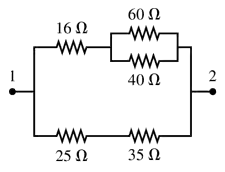
What is the equivalent resistance between points 1 and 2 in FIGURE EX28.27?
Circuit diagram showing resistors of 16Ω, 60Ω, 40Ω, 25Ω, and 35Ω connected between points 1 and 2.

Guida verificata passo dopo passo
1
Step 1: Identify the configuration of resistors in the circuit. The circuit contains resistors in series and parallel combinations. Specifically, the 60 Ω and 40 Ω resistors are in parallel, while the 16 Ω, 25 Ω, and 35 Ω resistors are in series with the equivalent resistance of the parallel combination.
Step 2: Calculate the equivalent resistance of the 60 Ω and 40 Ω resistors in parallel using the formula for parallel resistance: Req=11R1+1R2, where R₁ = 60 Ω and R₂ = 40 Ω.
Step 3: Add the equivalent resistance of the parallel combination to the resistors in series. The total equivalent resistance is given by: Rtotal=Req+16+25+35.
Step 4: Perform the addition of the resistances step by step. First, calculate the equivalent resistance of the parallel combination, then add the series resistances.
Step 5: Verify the result by ensuring all resistances are accounted for and the calculations follow the rules for combining resistors in series and parallel.

Risposta video verificata per un problema simile:

Questa soluzione video è stata consigliata dai nostri tutor come utile per risolvere questo problema.

Concetti chiave

Ecco i concetti essenziali che devi comprendere per rispondere correttamente alla domanda.

Equivalent Resistance

Equivalent resistance is the total resistance of a circuit that can replace multiple resistors. It simplifies the analysis of complex circuits by allowing us to treat them as a single resistor. The equivalent resistance can be calculated differently for resistors in series and parallel, affecting how current flows through the circuit.
Video consigliato:
Percorso guidato
03:44
Find Equivalent Capacitance #1

Series and Parallel Resistors

Resistors can be connected in series or parallel, which affects the total resistance. In a series connection, the total resistance is the sum of individual resistances, while in a parallel connection, the total resistance can be found using the formula 1/R_total = 1/R1 + 1/R2 + ... + 1/Rn. Understanding these configurations is crucial for calculating equivalent resistance.
Video consigliato:
Percorso guidato
12:42
Combining Resistors in Series & Parallel

Ohm's Law

Ohm's Law states that the current (I) through a conductor between two points is directly proportional to the voltage (V) across the two points and inversely proportional to the resistance (R). It is expressed as V = IR. This fundamental law is essential for analyzing circuits and understanding how voltage, current, and resistance interact.
Video consigliato:
Percorso guidato
03:07
Resistance and Ohm's Law