Ch 28: Fundamentals of Circuits
Knight Calc - Physics for Scientists and Engineers 5th Edition
Knight Calc5th EditionPhysics for Scientists and EngineersISBN: 9780137344796Non è quello che usi tu?Cambia libro di testo
Capitolo 28, Problema 23

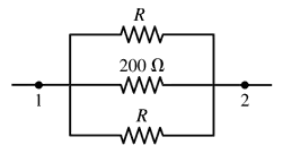
Two of the three resistors in FIGURE EX28.23 are unknown but equal. The total resistance between points 1 and 2 is 75Ω. What is the value of R?

Guida verificata passo dopo passo
1
Step 1: Analyze the circuit configuration. The circuit consists of three resistors: two resistors with unknown resistance R and one resistor with a resistance of 200Ω. The two resistors R are in parallel with each other, and this parallel combination is in series with the 200Ω resistor.
Step 2: Calculate the equivalent resistance of the two parallel resistors R. The formula for the equivalent resistance of two resistors in parallel is: Req=11R+1R. Simplify this expression to find the equivalent resistance of the parallel combination.
Step 3: Add the equivalent resistance of the parallel combination to the resistance of the 200Ω resistor, since the parallel combination is in series with the 200Ω resistor. The total resistance of resistors in series is given by: Rtotal=Req+200.
Step 4: Set the total resistance equal to the given value of 75Ω. This gives the equation: 75=11R+1R+200. Solve this equation for R.
Step 5: Rearrange and simplify the equation to isolate R. Use algebraic manipulation to solve for R, ensuring all terms are correctly handled. This will yield the value of R.

Risposta video verificata per un problema simile:

Questa soluzione video è stata consigliata dai nostri tutor come utile per risolvere questo problema.

Concetti chiave

Ecco i concetti essenziali che devi comprendere per rispondere correttamente alla domanda.

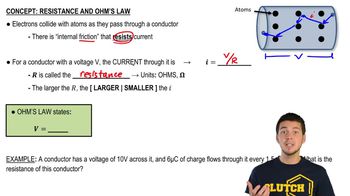
Ohm's Law

Ohm's Law states that the current (I) flowing through a conductor between two points is directly proportional to the voltage (V) across the two points and inversely proportional to the resistance (R) of the conductor. This relationship is expressed mathematically as V = IR. Understanding this law is crucial for analyzing electrical circuits and calculating unknown values such as current, voltage, or resistance.
Video consigliato:
Percorso guidato
03:07
Resistance and Ohm's Law

Series and Parallel Resistors

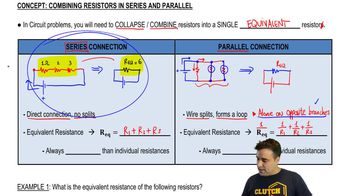
Resistors can be arranged in series or parallel configurations, affecting the total resistance in a circuit. In a series configuration, the total resistance is the sum of individual resistances (R_total = R1 + R2 + ...). In a parallel configuration, the total resistance can be calculated using the formula 1/R_total = 1/R1 + 1/R2 + ... This distinction is essential for solving problems involving multiple resistors, as seen in the given circuit.
Video consigliato:
Percorso guidato
12:42
Combining Resistors in Series & Parallel

Equivalent Resistance

Equivalent resistance is the total resistance of a circuit that can replace a combination of resistors without changing the current or voltage in the circuit. For resistors in parallel, the equivalent resistance is always less than the smallest individual resistor. In the context of the question, calculating the equivalent resistance between points 1 and 2 is necessary to find the unknown resistor value (R) when the total resistance is given.
Video consigliato:
Percorso guidato
03:44
Find Equivalent Capacitance #1