Ch 32: AC Circuits
Knight Calc - Physics for Scientists and Engineers 5th Edition
Knight Calc5th EditionPhysics for Scientists and EngineersISBN: 9780137344796Non è quello che usi tu?Cambia libro di testo
Capitolo 32, Problema 36

A resistor dissipates 2.0 W when the rms voltage of the emf is 10.0 V. At what rms voltage will the resistor dissipate 10.0 W?

Guida verificata passo dopo passo
1
Step 1: Recall the formula for power dissipated in a resistor: P = V2 / R, where P is the power, V is the rms voltage, and R is the resistance.
Step 2: Use the given data for the first case to calculate the resistance of the resistor. Rearrange the formula to solve for R: R = V2 / P. Substitute V = 10.0 V and P = 2.0 W.
Step 3: Once the resistance R is determined, use the same power formula for the second case where the power is 10.0 W. Rearrange the formula to solve for the new rms voltage V: V = P ⋅ R.
Step 4: Substitute the value of R (calculated in Step 2) and P = 10.0 W into the formula to find the new rms voltage.
Step 5: Simplify the expression to determine the new rms voltage. This will give the voltage at which the resistor dissipates 10.0 W.

Risposta video verificata per un problema simile:

Questa soluzione video è stata consigliata dai nostri tutor come utile per risolvere questo problema.

Concetti chiave

Ecco i concetti essenziali che devi comprendere per rispondere correttamente alla domanda.

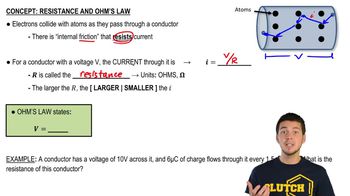
Ohm's Law

Ohm's Law states that the current (I) flowing through a conductor between two points is directly proportional to the voltage (V) across the two points and inversely proportional to the resistance (R) of the conductor. It is mathematically expressed as V = IR. This relationship is fundamental in understanding how voltage, current, and resistance interact in electrical circuits.
Video consigliato:
Percorso guidato
03:07
Resistance and Ohm's Law

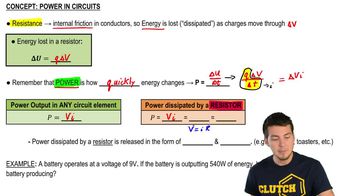
Power in Electrical Circuits

The power (P) dissipated by a resistor in an electrical circuit is given by the formula P = V^2 / R, where V is the voltage across the resistor and R is its resistance. This formula indicates that power is proportional to the square of the voltage, meaning that if the voltage increases, the power dissipated increases significantly, assuming resistance remains constant.
Video consigliato:
Percorso guidato
06:18
Power in Circuits

Root Mean Square (RMS) Voltage

RMS voltage is a statistical measure of the magnitude of a varying voltage. It represents the equivalent direct current (DC) voltage that would produce the same power dissipation in a resistor as the alternating current (AC) voltage does. For sinusoidal voltages, the RMS value is calculated as V_rms = V_peak / √2, which is crucial for analyzing AC circuits and understanding power dissipation.
Video consigliato:
Percorso guidato
05:21
Root-Mean-Square Speed of Ideal Gases