Which stable nuclei have a diameter of 7.46 fm?
Ch 42: Nuclear Physics
Knight Calc5th EditionPhysics for Scientists and EngineersISBN: 9780137344796Non è quello che usi tu?Cambia libro di testo
Capitolo 42, Problema 10
Calculate (in MeV) the total binding energy and the binding energy per nucleon for ¹²⁹I and for ¹²⁹Xe.
Guida verificata passo dopo passo1
Determine the number of protons (Z) and neutrons (N) for each isotope. For ¹²⁹I (Iodine), Z = 53 (atomic number of Iodine) and N = 129 - 53 = 76. For ¹²⁹Xe (Xenon), Z = 54 (atomic number of Xenon) and N = 129 - 54 = 75.
Use the semi-empirical mass formula or look up the experimental atomic masses of ¹²⁹I and ¹²⁹Xe in atomic mass units (u). Convert these masses into energy using the relation: \( E = m \cdot c^2 \), where \( c^2 = 931.5 \; \text{MeV/u} \).
Calculate the total binding energy for each isotope. The total binding energy is given by: \( B = \left[ Z \cdot m_p + N \cdot m_n - m_{nucleus} \right] \cdot c^2 \), where \( m_p \) is the mass of a proton, \( m_n \) is the mass of a neutron, and \( m_{nucleus} \) is the mass of the nucleus.
Determine the binding energy per nucleon for each isotope. This is calculated by dividing the total binding energy by the total number of nucleons (A): \( B_{per\;nucleon} = \frac{B}{A} \), where \( A = Z + N \).
Compare the binding energy per nucleon for ¹²⁹I and ¹²⁹Xe to understand their relative nuclear stability. A higher binding energy per nucleon indicates a more stable nucleus.

Risposta video verificata per un problema simile:
Questa soluzione video è stata consigliata dai nostri tutor come utile per risolvere questo problema.
Concetti chiave
Ecco i concetti essenziali che devi comprendere per rispondere correttamente alla domanda.
Binding Energy
Binding energy is the energy required to disassemble a nucleus into its constituent protons and neutrons. It is a measure of the stability of a nucleus; the higher the binding energy, the more stable the nucleus. This energy can be calculated using the mass defect, which is the difference between the mass of the individual nucleons and the mass of the nucleus itself.
Video consigliato:
Percorso guidato
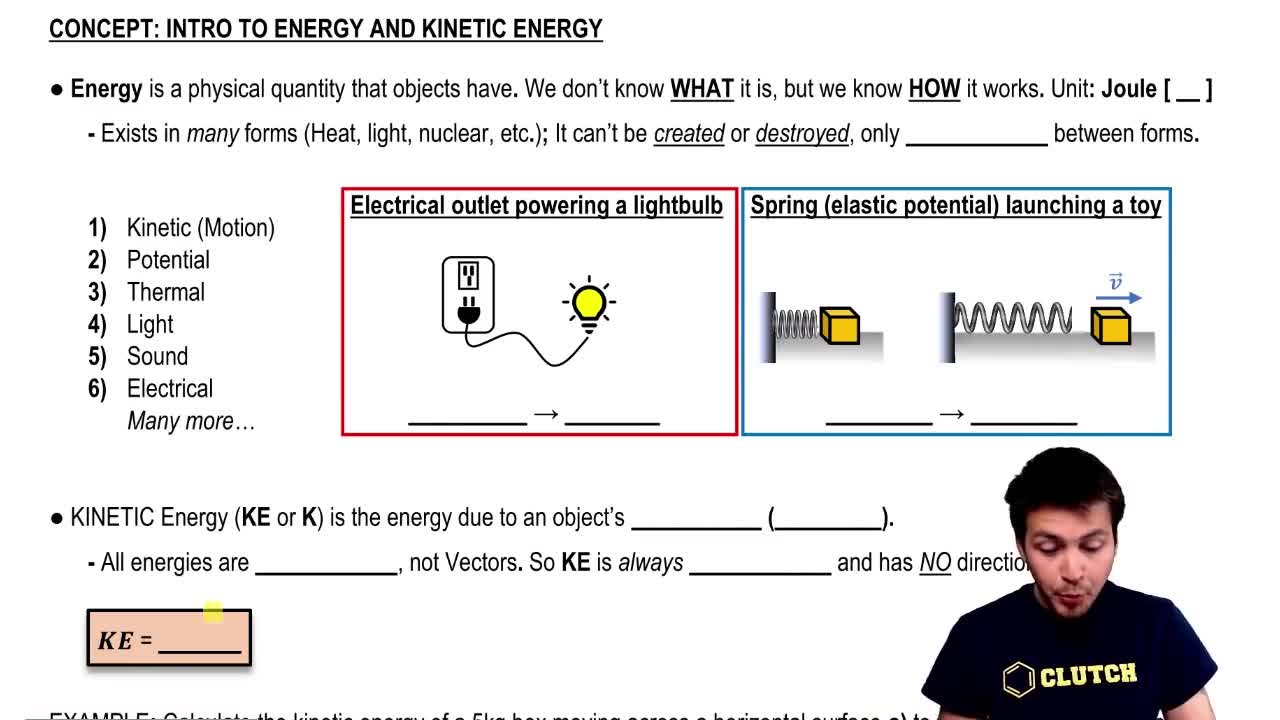
Intro to Energy & Types of Energy
Mass Defect
The mass defect refers to the difference in mass between the total mass of individual nucleons and the actual mass of the nucleus. This discrepancy arises because some mass is converted into energy during the formation of the nucleus, according to Einstein's equation E=mc². The mass defect is crucial for calculating the binding energy of a nucleus.
Video consigliato:
Percorso guidato
Mass Spectrometers
Binding Energy per Nucleon
Binding energy per nucleon is the average energy that binds each nucleon (proton or neutron) in the nucleus. It is calculated by dividing the total binding energy by the number of nucleons. This value is important for comparing the stability of different nuclei; generally, a higher binding energy per nucleon indicates a more stable nucleus.
Video consigliato:
Percorso guidato
Intro to Energy & Types of Energy
Pratica correlata
Domanda del libro di testo
78
views
Domanda del libro di testo
Draw energy-level diagrams, similar to Figure 42.11, for all A = 14 nuclei listed in Appendix C. Show all the occupied neutron and proton levels.
83
views
Domanda del libro di testo
Use the potential-energy diagram in Figure 42.8 to estimate the ratio of the gravitational potential energy to the nuclear potential energy for two neutrons separated by 1.0 fm.
88
views
Domanda del libro di testo
A Geiger counter is used to measure the decay of a radioactive isotope produced in a nuclear reactor. Initially, when the sample is first removed from the reactor, the Geiger counter registers 15,000 decays/s. 15 h later the count is down to 5500 decays/s. At what time after the sample's removal from the reactor is the count 1200 decays/s?
2530
views
Domanda del libro di testo
Calculate the nuclear diameters of (a) ⁴He, (b) ⁵⁶Fe, and (c) ²³⁸U.
110
views