Ch 42: Nuclear Physics
Knight Calc - Physics for Scientists and Engineers 5th Edition
Knight Calc5th EditionPhysics for Scientists and EngineersISBN: 9780137344796Non è quello che usi tu?Cambia libro di testo
Capitolo 42, Problema 3

Calculate the nuclear diameters of (a) ⁴He, (b) ⁵⁶Fe, and (c) ²³⁸U.

Guida verificata passo dopo passo
1
Understand the problem: The nuclear diameter can be estimated using the empirical formula for the radius of a nucleus, which is given by \( R = R_0 A^{1/3} \), where \( R_0 \) is a constant approximately equal to \( 1.2 \times 10^{-15} \, \text{m} \) (1.2 femtometers), and \( A \) is the mass number of the nucleus. The diameter is then \( D = 2R \).
For part (a), ⁴He: The mass number \( A = 4 \). Substitute \( A \) into the formula for the radius: \( R = R_0 A^{1/3} \). Then calculate the diameter using \( D = 2R \).
For part (b), ⁵⁶Fe: The mass number \( A = 56 \). Use the same formula \( R = R_0 A^{1/3} \) to find the radius, and then calculate the diameter \( D = 2R \).
For part (c), ²³⁸U: The mass number \( A = 238 \). Again, use the formula \( R = R_0 A^{1/3} \) to find the radius, and then calculate the diameter \( D = 2R \).
Summarize the results: After substituting the values of \( A \) for each nucleus and performing the calculations, you will have the nuclear diameters for ⁴He, ⁵⁶Fe, and ²³⁸U. Ensure all units are consistent and express the final diameters in meters or femtometers as appropriate.

Risposta video verificata per un problema simile:

Questa soluzione video è stata consigliata dai nostri tutor come utile per risolvere questo problema.

Concetti chiave

Ecco i concetti essenziali che devi comprendere per rispondere correttamente alla domanda.

Nuclear Diameter

The nuclear diameter refers to the size of an atomic nucleus, which is typically on the order of femtometers (10^-15 meters). It can be estimated using empirical formulas that relate the number of nucleons (protons and neutrons) to the radius of the nucleus, often expressed as R = R₀A^(1/3), where R₀ is a constant and A is the mass number.
Video consigliato:
Percorso guidato
03:55
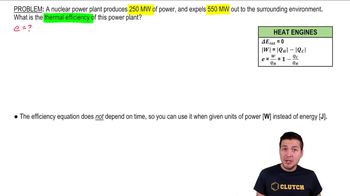
Efficiency of a Nuclear Power Plant

Mass Number

The mass number (A) of an atom is the total number of protons and neutrons in its nucleus. It is a crucial factor in determining the size of the nucleus, as larger mass numbers generally correspond to larger nuclear diameters. For example, helium (⁴He) has a mass number of 4, while iron (⁵⁶Fe) has a mass number of 56.
Video consigliato:
Percorso guidato
07:19
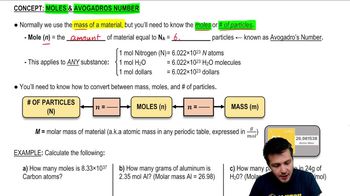
Moles & Avogadro's Number

Empirical Formula for Nuclear Size

The empirical formula for estimating nuclear size, R = R₀A^(1/3), provides a way to calculate the radius of a nucleus based on its mass number. The constant R₀ is approximately 1.2 to 1.3 femtometers. This formula highlights the relationship between the number of nucleons and the overall size of the nucleus, allowing for comparisons across different elements.
Video consigliato:
Percorso guidato
03:55
Efficiency of a Nuclear Power Plant