Ch 42: Nuclear Physics
Knight Calc - Physics for Scientists and Engineers 5th Edition
Knight Calc5th EditionPhysics for Scientists and EngineersISBN: 9780137344796Non è quello che usi tu?Cambia libro di testo
Capitolo 42, Problema 15

Use the potential-energy diagram in Figure 42.8 to estimate the ratio of the gravitational potential energy to the nuclear potential energy for two neutrons separated by 1.0 fm.

Guida verificata passo dopo passo
1
Identify the key quantities from the problem: gravitational potential energy and nuclear potential energy. Gravitational potential energy is given by the formula: Ug = - Gmmnr, where G is the gravitational constant, mn is the mass of a neutron, and r is the separation distance. Nuclear potential energy can be estimated from the potential-energy diagram provided in the problem.
From the potential-energy diagram (Figure 42.8), determine the nuclear potential energy at a separation distance of 1.0 fm (1.0 × 10⁻¹⁵ m). This value is typically negative and represents the attractive nuclear force between the neutrons.
Calculate the gravitational potential energy using the formula: Ug = - Gmmnr. Substitute the known values: G = 6.674 × 10⁻¹¹ m3 kg-1 s-2, mn = 1.675 × 10⁻²⁷ kg, and r = 1.0 × 10⁻¹⁵ m. This will yield the gravitational potential energy between the two neutrons.
Determine the ratio of gravitational potential energy to nuclear potential energy. This is done by dividing the magnitude of the gravitational potential energy by the magnitude of the nuclear potential energy: Ratio = |Ug|Un.
Interpret the result. The ratio will likely show that the nuclear potential energy is significantly stronger than the gravitational potential energy at this separation distance, reflecting the dominance of nuclear forces at subatomic scales.

Risposta video verificata per un problema simile:

Questa soluzione video è stata consigliata dai nostri tutor come utile per risolvere questo problema.

Concetti chiave

Ecco i concetti essenziali che devi comprendere per rispondere correttamente alla domanda.

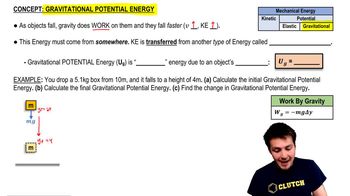
Gravitational Potential Energy

Gravitational potential energy (U_g) is the energy an object possesses due to its position in a gravitational field. It is calculated using the formula U_g = -G(m1*m2)/r, where G is the gravitational constant, m1 and m2 are the masses of the objects, and r is the distance between their centers. In the context of neutrons, this energy is relatively small compared to nuclear forces at short distances.
Video consigliato:
Percorso guidato
06:35
Gravitational Potential Energy

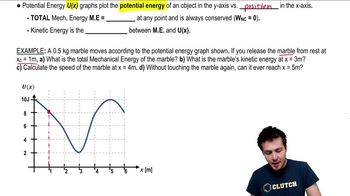
Nuclear Potential Energy

Nuclear potential energy (U_n) refers to the energy associated with the interactions between nucleons (protons and neutrons) within an atomic nucleus. This energy is significantly stronger than gravitational potential energy at very short ranges, typically on the order of femtometers (fm). The nuclear force is attractive at these distances, leading to a negative potential energy value that reflects the stability of the nucleus.
Video consigliato:
Percorso guidato
07:24
Potential Energy Graphs

Potential Energy Ratio

The potential energy ratio compares the magnitudes of gravitational potential energy to nuclear potential energy. This ratio is crucial for understanding the relative strengths of these forces acting on particles like neutrons. By estimating this ratio, one can infer the dominance of nuclear forces over gravitational forces at small scales, which is essential in nuclear physics and astrophysics.
Video consigliato:
Percorso guidato
07:24
Potential Energy Graphs