Ch. 5 - Complex Numbers, Polar Coordinates and Parametric Equations
Blitzer - Trigonometry 3rd Edition
Blitzer3rd EditionTrigonometryISBN: 9780137316601Non è quello che usi tu?Cambia libro di testo
Capitolo 5, Problema 17

In Exercises 11–20, use a polar coordinate system like the one shown for Exercises 1–10 to plot each point with the given polar coordinates. (−1, π)

Guida verificata passo dopo passo
1
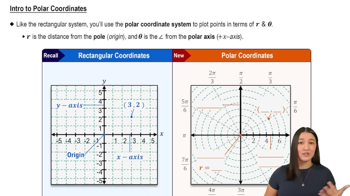
Recall that a point in polar coordinates is given as \((r, \theta)\), where \(r\) is the radius (distance from the origin) and \(\theta\) is the angle measured from the positive x-axis (polar axis).
Identify the given coordinates: here, \(r = -1\) and \(\theta = \pi\). The angle \(\pi\) radians corresponds to 180 degrees, which points directly to the left on the polar coordinate plane.
Since \(r\) is negative, instead of moving 1 unit in the direction of \(\pi\), move 1 unit in the opposite direction of \(\pi\). The opposite direction of \(\pi\) radians is \(\pi + \pi = 2\pi\) radians (or equivalently 0 radians, since angles are periodic).
Plot the point by starting at the origin, then moving 1 unit along the positive x-axis (0 radians) because of the negative radius, effectively reflecting the point across the origin.
Label the point clearly on the polar coordinate system, noting that the negative radius changes the direction of the point from the angle given.

Risposta video verificata per un problema simile:

Questa soluzione video è stata consigliata dai nostri tutor come utile per risolvere questo problema.
Durata del video:
1m

Concetti chiave

Ecco i concetti essenziali che devi comprendere per rispondere correttamente alla domanda.

Polar Coordinate System

The polar coordinate system represents points using a radius and an angle, denoted as (r, θ). The radius r indicates the distance from the origin, and θ is the angle measured counterclockwise from the positive x-axis. This system is useful for plotting points in a circular or rotational context.
Video consigliato:
Percorso guidato
05:32
Intro to Polar Coordinates

Negative Radius in Polar Coordinates

A negative radius means the point is plotted in the direction opposite to the angle θ. Instead of moving r units along θ, you move |r| units along θ + π radians. This concept helps in correctly locating points with negative radius values on the polar plane.
Video consigliato:
Percorso guidato
05:32
Intro to Polar Coordinates

Angle Measurement in Radians

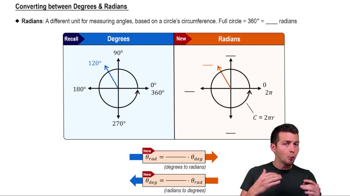
Angles in polar coordinates are often measured in radians, where π radians equals 180 degrees. Understanding radian measure is essential for accurately interpreting and plotting points, especially when converting between degrees and radians or when adding π to adjust direction.
Video consigliato:
Percorso guidato
5:04
Converting between Degrees & Radians