Domanda del libro di testo
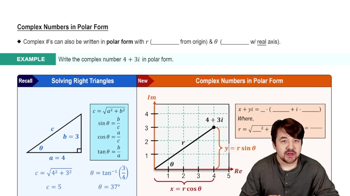
In Exercises 11–26, plot each complex number. Then write the complex number in polar form. You may express the argument in degrees or radians. −4i
467
views

 Blitzer 3rd EditionCh. 5 - Complex Numbers, Polar Coordinates and Parametric EquationsProblema 15
 Guida verificata passo dopo passo
 04:47
04:47
 5:02
5:02 2:25
2:25In Exercises 11–26, plot each complex number. Then write the complex number in polar form. You may express the argument in degrees or radians. −4i
Eliminate the parameter and graph the plane curve represented by the parametric equations. Use arrows to show the orientation of each plane curve. x = √t , y = t + 1; −∞ < t < ∞
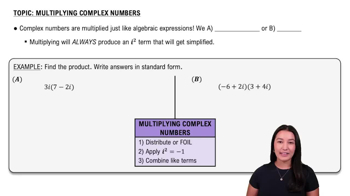
In Exercises 9–20, find each product and write the result in standard form. (−5 + i)(−5 − i)
In Exercises 11–20, use a polar coordinate system like the one shown for Exercises 1–10 to plot each point with the given polar coordinates. (3, 4π/3)
In Exercises 11–20, use a polar coordinate system like the one shown for Exercises 1–10 to plot each point with the given polar coordinates. (−1, π)