Ch. 5 - Complex Numbers, Polar Coordinates and Parametric Equations
Blitzer - Trigonometry 3rd Edition
Blitzer3rd EditionTrigonometryISBN: 9780137316601Non è quello che usi tu?Cambia libro di testo
Capitolo 5, Problema 17

In Exercises 9–20, find each product and write the result in standard form. (−5 + i)(−5 − i)

Guida verificata passo dopo passo
1
Recognize that the expression \((−5 + i)(−5 − i)\) is a product of two complex conjugates. Complex conjugates have the form \(a + bi\) and \(a - bi\).
Recall the formula for the product of complex conjugates: \((a + bi)(a - bi) = a^2 + b^2\). This results in a real number because the imaginary parts cancel out.
Identify \(a = -5\) and \(b = 1\) from the given expression \((−5 + i)(−5 − i)\).
Apply the formula by squaring \(a\) and \(b\) and then adding them: calculate \((-5)^2 + (1)^2\).
Write the result in standard form, which for complex numbers is \(x + yi\), but since the product of conjugates is real, the imaginary part will be zero.

Risposta video verificata per un problema simile:

Questa soluzione video è stata consigliata dai nostri tutor come utile per risolvere questo problema.
Durata del video:
3m

Concetti chiave

Ecco i concetti essenziali che devi comprendere per rispondere correttamente alla domanda.

Complex Numbers and Standard Form

Complex numbers are expressed in the form a + bi, where a is the real part and b is the imaginary part. The standard form refers to writing the result explicitly as a sum of a real number and an imaginary number. Understanding this form is essential for interpreting and simplifying complex number expressions.
Video consigliato:
Percorso guidato
04:47
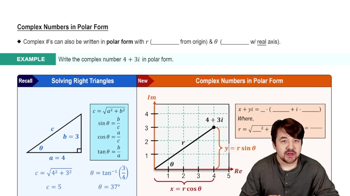
Complex Numbers In Polar Form

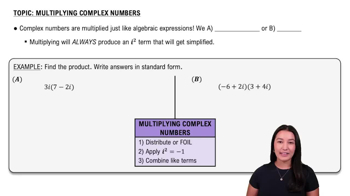
Multiplication of Complex Numbers

Multiplying complex numbers involves using the distributive property (FOIL method) and applying the rule i² = -1. Each term in the first complex number is multiplied by each term in the second, and like terms are combined to simplify the expression.
Video consigliato:
Percorso guidato
5:02
Multiplying Complex Numbers

Imaginary Unit Properties

The imaginary unit i is defined such that i² = -1. This property is crucial when simplifying products involving i, as it allows conversion of i² terms into real numbers, enabling the expression to be written in standard form.
Video consigliato:
Percorso guidato
2:20
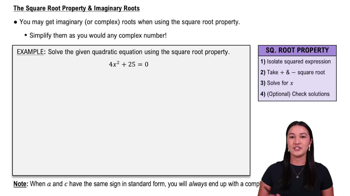
Imaginary Roots with the Square Root Property