Ch. 17 - Reactions of Aromatic Compounds
Wade - Organic Chemistry 9th Edition
Wade9th EditionOrganic ChemistryISBN: 9780135213728당신이 사용하는 게 아니라요?교과서 변경
17장, 문제 59

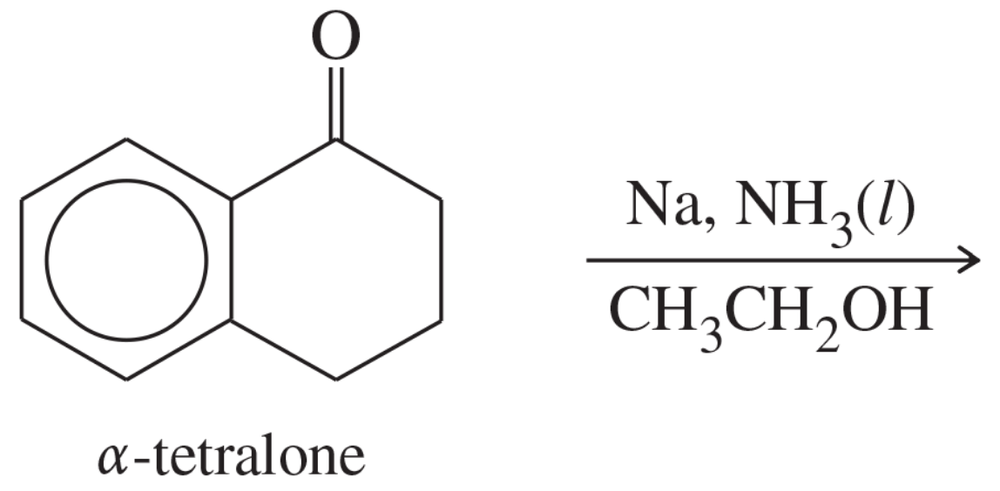
α-Tetralone undergoes Birch reduction to give an excellent yield of a single product. Predict the structure of the product, and propose a mechanism for its formation.

검증된 단계별 안내
1
Step 1: Understand the Birch reduction conditions. Birch reduction involves the use of sodium (Na) in liquid ammonia (NH₃(l)) and an alcohol (such as ethanol, CH₃CH₂OH) as a proton source. This reaction typically reduces aromatic rings or conjugated systems by adding electrons and protons to the molecule.
Step 2: Analyze the structure of α-tetralone. α-Tetralone consists of a bicyclic structure with a ketone group attached to a six-membered ring fused to a benzene ring. The ketone group is conjugated with the benzene ring, making it susceptible to reduction under Birch conditions.
Step 3: Predict the product of the Birch reduction. Under Birch reduction, the aromatic ring loses aromaticity and forms a 1,4-cyclohexadiene structure. The ketone group remains intact, as Birch reduction selectively reduces the aromatic ring without affecting the ketone functionality.
Step 4: Propose the mechanism for the formation of the product. The mechanism involves: (a) Electron transfer from sodium metal to the aromatic ring, forming a radical anion. (b) Protonation of the radical anion by ethanol, leading to a cyclohexadienyl radical. (c) A second electron transfer from sodium, forming a cyclohexadienyl anion. (d) Protonation of the anion by ethanol, resulting in the final 1,4-cyclohexadiene product.
Step 5: Confirm the regioselectivity of the reduction. Birch reduction typically reduces the positions of the aromatic ring that are not conjugated to electron-withdrawing groups. In α-tetralone, the ketone group directs the reduction to occur at the positions furthest from the ketone, leading to the formation of a single regioisomeric product.

비슷한 문제에 대한 검증된 영상 답변:

이 영상 해법은 위 문제에 도움이 된다고 튜터들이 추천한 것입니다.
영상 길이:
6m

주요 개념

질문에 올바르게 답하기 위해 반드시 이해해야 하는 핵심 개념들은 다음과 같습니다.

Birch Reduction

Birch reduction is a chemical reaction that involves the reduction of aromatic compounds using sodium metal in liquid ammonia, often in the presence of an alcohol. This reaction typically results in the formation of 1,4-cyclohexadienes from aromatic rings, effectively breaking the aromaticity and introducing double bonds in a specific pattern. Understanding this mechanism is crucial for predicting the structure of the product formed from α-tetralone.
추천 영상:
04:40
Birch Reduction Mechanism

Mechanism of Birch Reduction

The mechanism of Birch reduction involves the formation of radical anions through the one-electron transfer from sodium to the aromatic compound. This is followed by protonation and further reduction steps that lead to the formation of the final product. The specific conditions, such as the use of liquid ammonia and ethanol, influence the reaction pathway and the stability of intermediates, which is essential for predicting the product structure.
추천 영상:
04:40
Birch Reduction Mechanism

Product Structure Prediction

Predicting the structure of the product from a Birch reduction requires an understanding of how the reaction alters the original compound. In the case of α-tetralone, the reduction will lead to the formation of a cyclohexadiene derivative. Analyzing the positions of substituents and the nature of the double bonds formed during the reaction is key to accurately determining the final structure of the product.
추천 영상:
12:17
Predict the structure of the glycoside products