Measurements show that the pH of a particular lake is 4.0. What is the hydrogen ion concentration of the lake?
a. 4.0 M
b. 10−10M
c. 10−4M
d. 104M
검증된 단계별 안내
1
Understand that pH is a measure of the hydrogen ion concentration in a solution, defined as pH = -\(\log\)_{10}[H^+].
Given that the pH of the lake is 4.0, set up the equation: 4.0 = -\(\log\)_{10}[H^+].
To find the hydrogen ion concentration [H^+], rewrite the equation in exponential form: [H^+] = 10^{-4.0}.
Recognize that the expression 10^{-4.0} represents the hydrogen ion concentration in moles per liter (M).
Compare the calculated hydrogen ion concentration with the given options to identify the correct answer.
비슷한 문제에 대한 검증된 영상 답변:
이 영상 해법은 위 문제에 도움이 된다고 튜터들이 추천한 것입니다.
영상 길이:
1m
영상 재생:
0 댓글
주요 개념
질문에 올바르게 답하기 위해 반드시 이해해야 하는 핵심 개념들은 다음과 같습니다.
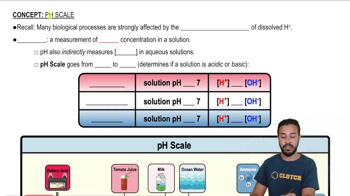
pH Scale
The pH scale measures the acidity or alkalinity of a solution, ranging from 0 to 14. A pH of 7 is neutral, while values below 7 indicate acidity and above 7 indicate alkalinity. Each unit change in pH represents a tenfold change in hydrogen ion concentration, making it crucial for understanding the relationship between pH and ion concentration.
Hydrogen ion concentration, expressed in moles per liter (M), quantifies the amount of H+ ions in a solution. It is directly related to pH, where the formula [H+] = 10^(-pH) allows for the calculation of hydrogen ion concentration from pH values. For example, a pH of 4.0 corresponds to a hydrogen ion concentration of 10^(-4) M.
The relationship between pH and hydrogen ion concentration is logarithmic, meaning that small changes in pH result in significant changes in H+ concentration. This is important for calculations involving pH, as it requires understanding that each unit decrease in pH increases the hydrogen ion concentration by a factor of ten, which is essential for solving the given question.

 1:10분
1:10분 검증된 단계별 안내
 07:58
07:58