A solution at pH 6 contains _________ H+ than the same amount of a solution at pH 8.
a. 20 times more
b. 100 times more
c. 2 times less
d. 100 times less
검증된 단계별 안내
1
Understand that pH is a measure of the hydrogen ion concentration \([H^+]\) in a solution.
Recall that the pH scale is logarithmic, meaning each whole number change on the scale represents a tenfold change in \([H^+]\).
Calculate the difference in pH between the two solutions: pH 6 and pH 8, which is 2 units.
Since the pH scale is logarithmic, a difference of 2 pH units means a \(10^2\) or 100-fold difference in \([H^+]\).
Determine that a solution at pH 6 has 100 times more \([H^+]\) than a solution at pH 8.
비슷한 문제에 대한 검증된 영상 답변:
이 영상 해법은 위 문제에 도움이 된다고 튜터들이 추천한 것입니다.
영상 길이:
2m
영상 재생:
0 댓글
주요 개념
질문에 올바르게 답하기 위해 반드시 이해해야 하는 핵심 개념들은 다음과 같습니다.
pH Scale
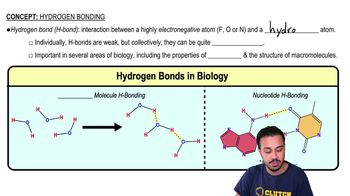
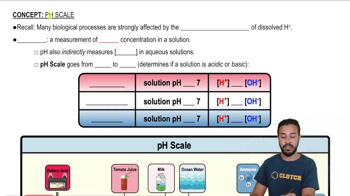
The pH scale measures the acidity or basicity of a solution, ranging from 0 to 14. A pH of 7 is neutral, while values below 7 indicate acidity and above 7 indicate alkalinity. Each whole number change on the pH scale represents a tenfold change in hydrogen ion concentration (H+), making it crucial for understanding the relationship between pH and H+ concentration.
Hydrogen ion concentration refers to the amount of H+ ions present in a solution, which directly affects its pH level. A lower pH indicates a higher concentration of H+ ions, while a higher pH indicates a lower concentration. For example, a solution at pH 6 has 10 times more H+ than at pH 7, and 100 times more than at pH 8.
The pH scale is logarithmic, meaning that each unit change in pH corresponds to a tenfold change in H+ concentration. Therefore, a solution with a pH of 6 has 100 times more H+ ions than a solution with a pH of 8. This concept is essential for calculating differences in acidity and understanding the implications of pH changes in chemical reactions.

 2:02분
2:02분 검증된 단계별 안내
 07:58
07:58