If you were given a solution that has a pH of 8.5, what would be its concentration of protons? What is the difference in proton concentration between this solution and one that has a pH of 7?
검증된 단계별 안내
1
Understand that pH is a measure of the hydrogen ion concentration in a solution, given by the formula \( \text{pH} = -\log[H^+] \).
To find the concentration of protons \([H^+]\) for a solution with a pH of 8.5, rearrange the formula to \([H^+] = 10^{-\text{pH}}\).
Substitute the pH value of 8.5 into the formula: \([H^+] = 10^{-8.5}\).
For the solution with a pH of 7, use the same formula: \([H^+] = 10^{-7}\).
Calculate the difference in proton concentration by subtracting the \([H^+]\) of the pH 8.5 solution from the \([H^+]\) of the pH 7 solution.
비슷한 문제에 대한 검증된 영상 답변:
이 영상 해법은 위 문제에 도움이 된다고 튜터들이 추천한 것입니다.
영상 길이:
44s
영상 재생:
0 댓글
주요 개념
질문에 올바르게 답하기 위해 반드시 이해해야 하는 핵심 개념들은 다음과 같습니다.
pH Scale
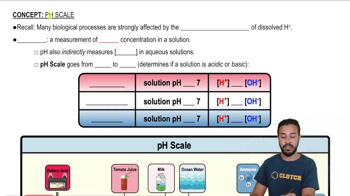
The pH scale measures the acidity or basicity of a solution, ranging from 0 to 14. A pH of 7 is considered neutral, values below 7 indicate acidity, and values above 7 indicate basicity. Each unit change in pH represents a tenfold change in hydrogen ion concentration, making it crucial for understanding the relationship between pH and proton concentration.
Hydrogen ion concentration, often expressed in moles per liter (M), is a measure of the amount of protons (H+) present in a solution. The concentration can be calculated using the formula [H+] = 10^(-pH). For example, a solution with a pH of 8.5 has a lower concentration of protons compared to one with a pH of 7, which is essential for comparing acidity levels.
Acid-base chemistry involves the study of acids, bases, and their reactions, including the transfer of protons. Understanding this concept is vital for interpreting how changes in pH affect proton concentration and the overall behavior of solutions. It helps explain why a solution with a higher pH (more basic) has fewer protons compared to a neutral solution.

 0:44분
0:44분 검증된 단계별 안내
 07:58
07:58