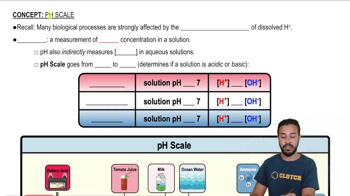
What is the hydroxide ion concentration of the lake described in question 3?
a. 10−10M
b. 10−4M
c. 10−7M
d. 10.0 M
검증된 단계별 안내
1
Identify the pH of the lake from question 3, as it is necessary to find the hydroxide ion concentration.
Recall the relationship between pH and pOH: \( \text{pH} + \text{pOH} = 14 \).
Calculate the pOH by subtracting the pH from 14.
Use the formula \( [\text{OH}^-] = 10^{-\text{pOH}} \) to find the hydroxide ion concentration.
Compare the calculated hydroxide ion concentration with the given options to determine the correct answer.
비슷한 문제에 대한 검증된 영상 답변:
이 영상 해법은 위 문제에 도움이 된다고 튜터들이 추천한 것입니다.
영상 길이:
2m
영상 재생:
0 댓글
주요 개념
질문에 올바르게 답하기 위해 반드시 이해해야 하는 핵심 개념들은 다음과 같습니다.
Hydroxide Ion Concentration
Hydroxide ion concentration ([OH⁻]) refers to the amount of hydroxide ions present in a solution, typically measured in moles per liter (M). It is crucial for determining the pH of a solution, as pH and pOH are related through the equation pH + pOH = 14 at 25°C. Understanding this concept is essential for calculating the concentration of hydroxide ions in the lake.
The pH scale measures the acidity or basicity of a solution, with lower values indicating higher acidity and higher values indicating higher basicity. The pOH scale is similarly defined for hydroxide ion concentration. The relationship between pH and pOH is fundamental in chemistry, as it allows for the conversion between the two, which is necessary for solving problems related to ion concentrations in solutions.
The water ion product (Kw) is the equilibrium constant for the self-ionization of water, defined as Kw = [H⁺][OH⁻] = 1.0 x 10⁻¹⁴ at 25°C. This constant is vital for calculating hydroxide ion concentration when the hydrogen ion concentration is known. It provides a foundational understanding of how the concentrations of H⁺ and OH⁻ ions interact in aqueous solutions, particularly in neutral, acidic, or basic environments.

 2:21분
2:21분 검증된 단계별 안내
 03:35
03:35