
Ch. 24 The Urinary System
Amerman- Human Anatomy & Physiology 3e
Amerman3rd EditionHuman Anatomy & PhysiologyISBN: 9780138247201, 9780138247928, 9780138201814당신이 사용하는 게 아니라요?교과서 변경
24장, 문제 10

The route by which substances are reabsorbed by crossing through the cells of the renal tubule and collecting system is known as the:
a. Paracellular route
b. Transcellular route
c. Primary active transport route
d. Facultative route

검증된 단계별 안내
1
Understand the context: The question is about the reabsorption of substances in the kidneys, specifically in the renal tubule and collecting system. Reabsorption involves moving substances from the filtrate back into the blood.
Review the two main routes of reabsorption: (1) The paracellular route, where substances pass between adjacent cells, and (2) the transcellular route, where substances pass through the cells themselves, crossing both the apical and basolateral membranes.
Clarify the mechanisms: The transcellular route often involves active or passive transport mechanisms, such as primary active transport (e.g., sodium-potassium pumps) or facilitated diffusion, depending on the substance being reabsorbed.
Eliminate incorrect options: (a) The paracellular route involves movement between cells, not through them. (c) Primary active transport is a mechanism, not a route. (d) Facultative reabsorption refers to water reabsorption regulated by hormones like ADH, not a specific route.
Conclude: The correct answer is the transcellular route, as it describes the process of substances crossing through the cells of the renal tubule and collecting system.

비슷한 문제에 대한 검증된 영상 답변:

이 영상 해법은 위 문제에 도움이 된다고 튜터들이 추천한 것입니다.
도움이 되었나요?

주요 개념

질문에 올바르게 답하기 위해 반드시 이해해야 하는 핵심 개념들은 다음과 같습니다.

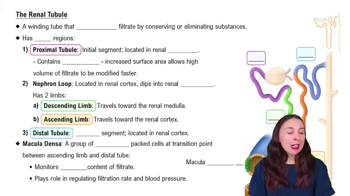
Renal Tubule Function

The renal tubule is a critical component of the nephron in the kidney, responsible for the reabsorption of water, ions, and nutrients from the filtrate back into the bloodstream. Understanding its structure and function is essential for grasping how substances are processed in the kidney.
추천 영상:
4:21
The Renal Tubule

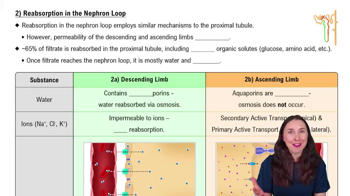
Reabsorption Mechanisms

Reabsorption in the renal tubule occurs through two primary mechanisms: paracellular and transcellular routes. The paracellular route involves substances passing between cells, while the transcellular route requires substances to cross the cell membrane, often involving transport proteins and energy.
추천 영상:
3:25
2) Reabsorption in the Nephron Loop

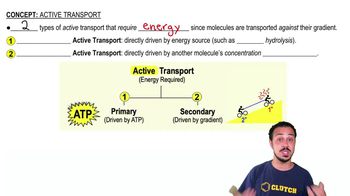
Active Transport

Active transport is a process that moves substances against their concentration gradient, requiring energy, typically in the form of ATP. This mechanism is crucial for the reabsorption of certain ions and molecules in the renal tubule, distinguishing it from passive transport methods.
추천 영상:
가이드 코스
02:37
Active Transport
관련 실천
교과서 질문

Which of the following conditions does not contribute to the creation and/or maintenance of the medullary osmotic gradient?

a. The countercurrent exchanger of the vasa recta

b. The countercurrent multiplier of the nephron loops of cortical nephrons

c. The countercurrent multiplier of the nephron loops of juxtamedullary nephrons

d. The permeability of the medullary collecting system to urea and other ions

759
views
교과서 질문

Glomerular hydrostatic pressure _____ filtration; colloid osmotic pressure and capsular hydrostatic pressure_____ filtration.

a. Favors; favor

b. Opposes; oppose

c. Favors; oppose

d. Opposes; favor

707
views
교과서 질문

Which of the following is false about the GFR?

a. The GFR averages about 120 ml/min

b. The GFR increases when the afferent arteriole dilates

c. The GFR decreases when the efferent arteriole constricts

d. The GFR decreases when the afferent arteriole constricts

865
views
교과서 질문

Dilute urine is produced when decreased levels of______ are secreted.

a. Aldosterone

b. Atrial natriuretic peptide

c. ADH

d. None of the above

716
views
교과서 질문

Mark the following statements as true or false. If a statement is false, correct it to make a true statement.

e. Obligatory water reabsorption occurs in the distal tubule and collecting system.

819
views
1
rank
교과서 질문

Fill in the blanks for the following statements:

a. When the GFR decreases, the macula densa releases chemicals to______ the afferent arteriole.

b. The sympathetic nervous system______ the blood vessels supplying the kidney _____ to the glomerular filtration rate.

c. The enzyme _____ is released by JG cells in response to a decrease in the GFR.

d. The enzyme ______ converts angiotensin-I to angiotensin-II.

e. Generally, angiotensin-II______ systemic blood pressure while _____ the GFR.

797
views
1
rank