Ch. 24 The Urinary System
Amerman- Human Anatomy & Physiology 3e
Amerman3rd EditionHuman Anatomy & PhysiologyISBN: 9780138247201, 9780138247928, 9780138201814당신이 사용하는 게 아니라요?교과서 변경
24장, 문제 13

Which of the following conditions does not contribute to the creation and/or maintenance of the medullary osmotic gradient?
a. The countercurrent exchanger of the vasa recta
b. The countercurrent multiplier of the nephron loops of cortical nephrons
c. The countercurrent multiplier of the nephron loops of juxtamedullary nephrons
d. The permeability of the medullary collecting system to urea and other ions

검증된 단계별 안내
1
Understand the medullary osmotic gradient: The medullary osmotic gradient is a concentration gradient in the kidney's medulla that allows for water reabsorption and urine concentration. It is primarily established and maintained by the countercurrent mechanisms and urea recycling.
Review the role of the countercurrent multiplier: The countercurrent multiplier occurs in the nephron loops of juxtamedullary nephrons. These loops actively transport ions (e.g., Na+ and Cl−) out of the ascending limb, creating a gradient that concentrates the medulla.
Analyze the role of the countercurrent exchanger: The countercurrent exchanger occurs in the vasa recta, the capillaries surrounding the nephron loops. It helps preserve the medullary osmotic gradient by allowing water and solutes to move passively, preventing washout of the gradient.
Evaluate the permeability of the medullary collecting system: The medullary collecting ducts are permeable to urea and other ions under the influence of antidiuretic hormone (ADH). This permeability contributes to the recycling of urea, which further enhances the medullary osmotic gradient.
Identify the incorrect option: The nephron loops of cortical nephrons do not significantly contribute to the medullary osmotic gradient because they are shorter and do not extend deep into the medulla. Therefore, the countercurrent multiplier of cortical nephrons is not involved in creating or maintaining the gradient.

비슷한 문제에 대한 검증된 영상 답변:

이 영상 해법은 위 문제에 도움이 된다고 튜터들이 추천한 것입니다.
도움이 되었나요?

주요 개념

질문에 올바르게 답하기 위해 반드시 이해해야 하는 핵심 개념들은 다음과 같습니다.

Medullary Osmotic Gradient

The medullary osmotic gradient is a crucial physiological feature of the kidney that allows for the concentration of urine. It is established by the differential permeability of the nephron segments and the countercurrent mechanisms, which create a gradient of osmolarity in the renal medulla. This gradient is essential for the reabsorption of water and solutes, enabling the body to maintain fluid balance.
추천 영상:
가이드 코스
04:51
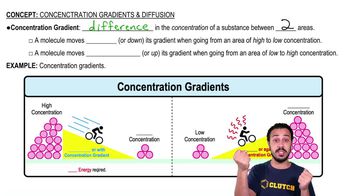
Concentration Gradients and Diffusion

Countercurrent Multiplier

The countercurrent multiplier is a mechanism in the nephron, particularly in the loops of Henle, that enhances the osmotic gradient in the renal medulla. It involves the flow of filtrate in opposite directions through the descending and ascending limbs, allowing for the active transport of ions and the passive movement of water. This process is vital for producing concentrated urine and is more pronounced in juxtamedullary nephrons compared to cortical nephrons.
추천 영상:
가이드 코스
2:35
Erythrocytes: Hemoglobin Example 2

Vasa Recta

The vasa recta are specialized capillaries that run parallel to the nephron loops and play a key role in maintaining the medullary osmotic gradient. They function as a countercurrent exchanger, allowing for the exchange of water and solutes without dissipating the osmotic gradient established by the nephron. This mechanism ensures that the blood supply to the kidney does not interfere with the concentration of urine, preserving the gradient necessary for effective water reabsorption.
추천 영상:
6:37
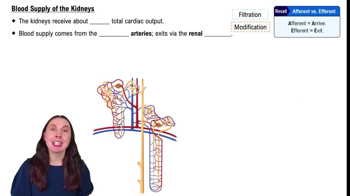
Blood Supply to the Kidneys