
Ch. 24 The Urinary System
Amerman- Human Anatomy & Physiology 3e
Amerman3rd EditionHuman Anatomy & PhysiologyISBN: 9780138247201, 9780138247928, 9780138201814당신이 사용하는 게 아니라요?교과서 변경
24장, 문제 11

Glomerular hydrostatic pressure _____ filtration; colloid osmotic pressure and capsular hydrostatic pressure_____ filtration.
a. Favors; favor
b. Opposes; oppose
c. Favors; oppose
d. Opposes; favor

검증된 단계별 안내
1
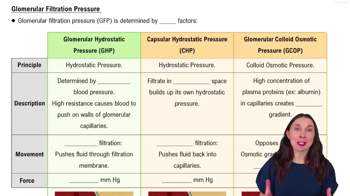
Understand the forces involved in glomerular filtration: Glomerular hydrostatic pressure (GHP) is the pressure exerted by blood within the glomerular capillaries, which pushes fluid out of the capillaries into the Bowman's capsule, favoring filtration. Colloid osmotic pressure (COP) is the pressure exerted by plasma proteins in the blood, which pulls water back into the capillaries, opposing filtration. Capsular hydrostatic pressure (CHP) is the pressure exerted by the fluid already in the Bowman's capsule, which also opposes filtration.
Analyze the role of glomerular hydrostatic pressure: Since GHP pushes fluid out of the capillaries into the Bowman's capsule, it favors filtration. This is the primary driving force for filtration in the glomerulus.
Analyze the role of colloid osmotic pressure: COP is caused by the presence of plasma proteins in the blood, which attract water back into the capillaries. This opposes filtration by counteracting the outward movement of fluid.
Analyze the role of capsular hydrostatic pressure: CHP is the pressure exerted by the fluid already present in the Bowman's capsule. This pressure resists the entry of additional fluid, opposing filtration.
Combine the information: Based on the roles of these pressures, glomerular hydrostatic pressure favors filtration, while colloid osmotic pressure and capsular hydrostatic pressure oppose filtration. Use this understanding to select the correct answer from the options provided.

비슷한 문제에 대한 검증된 영상 답변:

이 영상 해법은 위 문제에 도움이 된다고 튜터들이 추천한 것입니다.
도움이 되었나요?

주요 개념

질문에 올바르게 답하기 위해 반드시 이해해야 하는 핵심 개념들은 다음과 같습니다.

Glomerular Hydrostatic Pressure

Glomerular hydrostatic pressure is the blood pressure within the glomeruli of the kidneys. It plays a crucial role in the filtration process by pushing water and solutes out of the blood and into the Bowman’s capsule. This pressure is essential for initiating the formation of urine and is influenced by factors such as blood volume and systemic blood pressure.
추천 영상:
3:49
Glomerular Filtration Pressure

Colloid Osmotic Pressure

Colloid osmotic pressure is the pressure exerted by proteins, primarily albumin, in the blood plasma that draws water back into the circulatory system. This pressure opposes filtration by counteracting the effects of hydrostatic pressure, thus preventing excessive loss of fluid from the blood vessels into the renal tubules. It is a key factor in maintaining fluid balance in the body.
추천 영상:
6:12
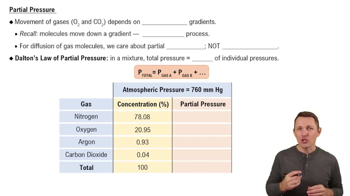
Partial Pressure

Capsular Hydrostatic Pressure

Capsular hydrostatic pressure is the pressure exerted by the fluid already present in the Bowman’s capsule. This pressure opposes the glomerular hydrostatic pressure and thus opposes filtration. It is important for regulating the amount of fluid that is filtered from the blood into the nephron, ensuring that the kidneys function efficiently.
추천 영상:
6:12
Partial Pressure
관련 실천
교과서 질문

Which of the following conditions does not contribute to the creation and/or maintenance of the medullary osmotic gradient?

a. The countercurrent exchanger of the vasa recta

b. The countercurrent multiplier of the nephron loops of cortical nephrons

c. The countercurrent multiplier of the nephron loops of juxtamedullary nephrons

d. The permeability of the medullary collecting system to urea and other ions

759
views
교과서 질문

Which of the following is false about the GFR?

a. The GFR averages about 120 ml/min

b. The GFR increases when the afferent arteriole dilates

c. The GFR decreases when the efferent arteriole constricts

d. The GFR decreases when the afferent arteriole constricts

865
views
교과서 질문

Dilute urine is produced when decreased levels of______ are secreted.

a. Aldosterone

b. Atrial natriuretic peptide

c. ADH

d. None of the above

716
views
교과서 질문

The kidneys produce _____ urine when the osmolarity of the body's fluids increases. They produce _____ urine when the osmolarity of the body's fluids decreases.

915
views
교과서 질문

The route by which substances are reabsorbed by crossing through the cells of the renal tubule and collecting system is known as the:

a. Paracellular route

b. Transcellular route

c. Primary active transport route

d. Facultative route

716
views
교과서 질문

Fill in the blanks for the following statements:

a. When the GFR decreases, the macula densa releases chemicals to______ the afferent arteriole.

b. The sympathetic nervous system______ the blood vessels supplying the kidney _____ to the glomerular filtration rate.

c. The enzyme _____ is released by JG cells in response to a decrease in the GFR.

d. The enzyme ______ converts angiotensin-I to angiotensin-II.

e. Generally, angiotensin-II______ systemic blood pressure while _____ the GFR.

797
views
1
rank