Ch. 11 Cardiovascular System
Marieb - Essentials of Human Anatomy & Physiology 13th Edition
Marieb13th EditionEssentials of Human Anatomy & PhysiologyISBN: 9780135624340당신이 사용하는 게 아니라요?교과서 변경
11장, 문제 5

More than one choice may apply.
Atrial repolarization coincides in time with the
a. P wave
b. T wave
c. QRS wave
d. P-Q interval

검증된 단계별 안내
1
Understand the concept of atrial repolarization: Atrial repolarization is the process by which the atria return to their resting electrical state after depolarization. This occurs after the atria have contracted and is typically masked by other electrical events in the heart.
Review the components of an electrocardiogram (ECG): The P wave represents atrial depolarization, the QRS complex represents ventricular depolarization, and the T wave represents ventricular repolarization. The P-Q interval is the time between the start of atrial depolarization and the start of ventricular depolarization.
Recognize that atrial repolarization is not directly visible on an ECG: Atrial repolarization coincides with the QRS complex, which represents ventricular depolarization. The electrical activity of atrial repolarization is overshadowed by the larger electrical signal of the QRS complex.
Eliminate incorrect options: The P wave represents atrial depolarization, not repolarization. The T wave represents ventricular repolarization, not atrial repolarization. The P-Q interval is a time measurement and does not directly represent atrial repolarization.
Conclude that atrial repolarization coincides with the QRS wave: This is because the electrical activity of atrial repolarization occurs simultaneously with ventricular depolarization, which is represented by the QRS complex.

비슷한 문제에 대한 검증된 영상 답변:

이 영상 해법은 위 문제에 도움이 된다고 튜터들이 추천한 것입니다.
영상 길이:
2m
도움이 되었나요?

주요 개념

질문에 올바르게 답하기 위해 반드시 이해해야 하는 핵심 개념들은 다음과 같습니다.

Atrial Repolarization

Atrial repolarization refers to the process by which the atria of the heart recover from depolarization after contraction. This electrical event is not typically visible on an electrocardiogram (ECG) as a distinct wave, but it occurs during the QRS complex, which represents ventricular depolarization.
추천 영상:
가이드 코스
9:24
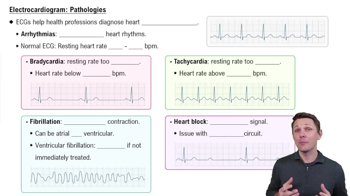
Electrocardiogram: Pathologies

Electrocardiogram (ECG) Waves

An electrocardiogram (ECG) displays the electrical activity of the heart through various waves: the P wave represents atrial depolarization, the QRS complex represents ventricular depolarization, and the T wave represents ventricular repolarization. Understanding these waves is crucial for interpreting cardiac function and identifying abnormalities.
추천 영상:
가이드 코스
4:36
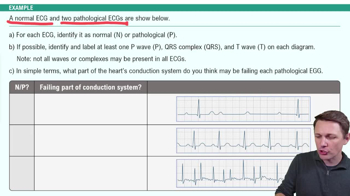
Electrocardiogram (ECG) Example 2

QRS Complex

The QRS complex is a key component of the ECG that reflects the rapid depolarization of the ventricles. It typically masks the atrial repolarization, which occurs simultaneously, making it important to recognize that while atrial repolarization happens during this time, it is not represented as a separate wave on the ECG.
추천 영상:
2:31
Major Histocompatibility Complexes