Ch. 11 Cardiovascular System
Marieb - Essentials of Human Anatomy & Physiology 13th Edition
Marieb13th EditionEssentials of Human Anatomy & PhysiologyISBN: 9780135624340당신이 사용하는 게 아니라요?교과서 변경
11장, 문제 2

More than one choice may apply.
Given a volume of 150 ml at the end of diastole, a volume of 50 ml at the end of systole, and a heart rate of 60 bpm, the cardiac output is
a. 600 ml/min
b. 6 liters/min
c. 1200 ml/min
d. 3 liters/min

검증된 단계별 안내
1
Step 1: Understand the formula for cardiac output (CO). Cardiac output is calculated using the formula: CO = Stroke Volume (SV) × Heart Rate (HR).
Step 2: Calculate the Stroke Volume (SV). Stroke Volume is the difference between the end-diastolic volume (EDV) and the end-systolic volume (ESV). Use the formula: SV = EDV - ESV. Substitute the given values: EDV = 150 ml and ESV = 50 ml.
Step 3: Multiply the Stroke Volume (SV) by the Heart Rate (HR) to find the Cardiac Output (CO). Use the formula: CO = SV × HR. Substitute the calculated SV and the given HR = 60 bpm.
Step 4: Convert the cardiac output to the appropriate units if necessary. Cardiac output is often expressed in liters per minute (L/min). To convert ml/min to L/min, divide the result by 1000.
Step 5: Compare the calculated cardiac output to the multiple-choice options provided (a, b, c, d) to determine the correct answer(s).

비슷한 문제에 대한 검증된 영상 답변:

이 영상 해법은 위 문제에 도움이 된다고 튜터들이 추천한 것입니다.
영상 길이:
2m
도움이 되었나요?

주요 개념

질문에 올바르게 답하기 위해 반드시 이해해야 하는 핵심 개념들은 다음과 같습니다.

Cardiac Output

Cardiac output (CO) is the volume of blood the heart pumps per minute, calculated as the product of stroke volume (SV) and heart rate (HR). It is a crucial measure of heart function and overall cardiovascular health. In this context, CO can be determined using the formula CO = SV × HR, where SV is the difference between end-diastolic volume and end-systolic volume.
추천 영상:
가이드 코스
9:44
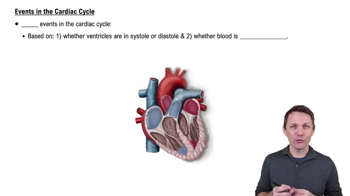
Events in the Cardiac Cycle

Stroke Volume

Stroke volume (SV) is the amount of blood ejected by the heart with each beat. It is calculated by subtracting the end-systolic volume (ESV) from the end-diastolic volume (EDV). In this question, the stroke volume can be calculated as SV = EDV - ESV, which helps in determining the cardiac output when combined with the heart rate.
추천 영상:

Heart Rate

Heart rate (HR) is the number of times the heart beats in one minute, typically measured in beats per minute (bpm). It is a vital sign that reflects the heart's activity and is a key component in calculating cardiac output. In this scenario, the heart rate is given as 60 bpm, which is essential for determining the overall cardiac output when multiplied by the stroke volume.
추천 영상:
가이드 코스
6:13
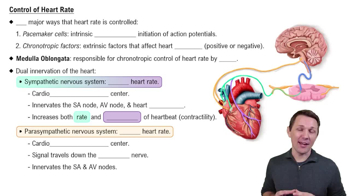
Control of Heart Rate