Ch. 11 Cardiovascular System
Marieb - Essentials of Human Anatomy & Physiology 13th Edition
Marieb13th EditionEssentials of Human Anatomy & PhysiologyISBN: 9780135624340당신이 사용하는 게 아니라요?교과서 변경
11장, 문제 16

More than one choice may apply.
Which heart chamber pumps blood with the greatest amount of force?
a. Right atrium
b. Right ventricle
c. Left atrium
d. Left ventricle

검증된 단계별 안내
1
Understand the function of each heart chamber: The heart has four chambers—two atria (right and left) and two ventricles (right and left). The atria receive blood, while the ventricles pump blood out of the heart.
Compare the roles of the ventricles: The right ventricle pumps blood to the lungs via the pulmonary artery, which requires less force because the lungs are nearby. The left ventricle pumps blood to the entire body via the aorta, which requires significantly more force to overcome systemic resistance.
Analyze the structural differences: The left ventricle has a thicker muscular wall compared to the right ventricle. This adaptation allows it to generate the higher pressure needed to pump blood throughout the body.
Eliminate the atria as options: The atria (right and left) primarily function to receive blood and push it into the ventricles. They do not pump blood with significant force compared to the ventricles.
Conclude based on physiological principles: The left ventricle is the chamber that pumps blood with the greatest amount of force due to its role in systemic circulation and its thicker muscular wall.

비슷한 문제에 대한 검증된 영상 답변:

이 영상 해법은 위 문제에 도움이 된다고 튜터들이 추천한 것입니다.
영상 길이:
2m
도움이 되었나요?

주요 개념

질문에 올바르게 답하기 위해 반드시 이해해야 하는 핵심 개념들은 다음과 같습니다.

Heart Chambers

The heart consists of four chambers: two atria (right and left) and two ventricles (right and left). The atria receive blood, while the ventricles pump it out. Understanding the function of each chamber is crucial for determining which one exerts the most force during contraction.
추천 영상:
6:13
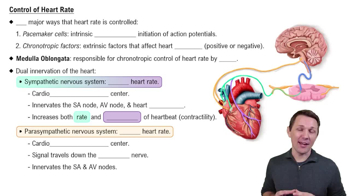
Control of Heart Rate

Ventricular Function

The ventricles are responsible for pumping blood to the lungs and the rest of the body. The left ventricle, in particular, has thicker muscular walls compared to the right ventricle, allowing it to generate higher pressure and force to deliver oxygenated blood throughout the systemic circulation.
추천 영상:
가이드 코스
06:04
Functional Groups

Cardiac Output and Pressure

Cardiac output refers to the volume of blood the heart pumps per minute, while pressure is the force exerted by the blood against the walls of the arteries. The left ventricle generates the highest pressure to overcome systemic vascular resistance, making it the chamber that pumps blood with the greatest force.
추천 영상:
6:12
Partial Pressure