Ch. 13 The Respiratory System
Marieb - Essentials of Human Anatomy & Physiology 13th Edition
Marieb13th EditionEssentials of Human Anatomy & PhysiologyISBN: 9780135624340당신이 사용하는 게 아니라요?교과서 변경
13장, 문제 6

More than one choice may apply.
Which of the following changes will accompany the loss of lung elasticity associated with aging?
a. Increase in tidal volume
b. Increase in inspiratory reserve volume
c. Increase in residual volume
d. Increase in vital capacity

검증된 단계별 안내
1
Understand the concept of lung elasticity: Lung elasticity refers to the ability of the lungs to return to their original shape after being stretched or filled with air. With aging, the elastic fibers in the lungs degrade, leading to reduced elasticity.
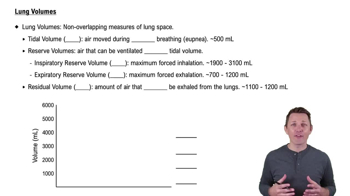
Analyze the impact of reduced lung elasticity on tidal volume: Tidal volume is the amount of air inhaled or exhaled during a normal breath. Reduced elasticity does not typically increase tidal volume; instead, it may remain stable or decrease slightly due to less efficient lung function.
Evaluate the effect on inspiratory reserve volume: Inspiratory reserve volume is the additional air that can be inhaled after a normal inhalation. Reduced lung elasticity limits the ability to expand the lungs fully, so inspiratory reserve volume is likely to decrease rather than increase.
Consider the changes in residual volume: Residual volume is the amount of air remaining in the lungs after a maximal exhalation. With reduced elasticity, the lungs may not recoil effectively, leading to an increase in residual volume as air becomes trapped in the lungs.
Assess the impact on vital capacity: Vital capacity is the total amount of air that can be exhaled after a maximal inhalation. Reduced lung elasticity decreases the ability to inhale and exhale fully, leading to a decrease in vital capacity rather than an increase.

비슷한 문제에 대한 검증된 영상 답변:

이 영상 해법은 위 문제에 도움이 된다고 튜터들이 추천한 것입니다.
영상 길이:
1m
도움이 되었나요?

주요 개념

질문에 올바르게 답하기 위해 반드시 이해해야 하는 핵심 개념들은 다음과 같습니다.

Lung Elasticity

Lung elasticity refers to the ability of lung tissue to stretch and recoil during breathing. As individuals age, the elastic fibers in the lungs can become less effective, leading to decreased lung compliance and impaired gas exchange. This loss of elasticity can significantly affect respiratory volumes and capacities.
추천 영상:
6:28
Lung Volumes

Tidal Volume and Respiratory Volumes

Tidal volume is the amount of air inhaled or exhaled during normal breathing. Understanding the different respiratory volumes, including inspiratory reserve volume, residual volume, and vital capacity, is crucial for assessing lung function. Changes in these volumes can indicate how aging affects respiratory mechanics.
추천 영상:
6:28
Lung Volumes

Residual Volume

Residual volume is the amount of air remaining in the lungs after a maximal exhalation. With aging and the loss of lung elasticity, residual volume tends to increase because the lungs cannot fully expel air. This change can lead to reduced efficiency in gas exchange and may contribute to respiratory issues in older adults.
추천 영상:
6:28
Lung Volumes