Ch. 2 Basic Chemistry
Marieb - Essentials of Human Anatomy & Physiology 13th Edition
Marieb13th EditionEssentials of Human Anatomy & PhysiologyISBN: 9780135624340당신이 사용하는 게 아니라요?교과서 변경
2장, 문제 7

Absence of which of the following nitrogen-containing bases would prevent RNA synthesis?
a. Adenine
b. Cytosine
c. Guanine
d. Thymine
e. Uracil

검증된 단계별 안내
1
Step 1: Understand the structure of RNA. RNA is a nucleic acid composed of a sugar-phosphate backbone and nitrogen-containing bases. The bases in RNA are adenine (A), cytosine (C), guanine (G), and uracil (U). Unlike DNA, RNA does not contain thymine (T).
Step 2: Recall the role of nitrogen-containing bases in RNA synthesis. These bases pair with complementary bases on the DNA template during transcription. Adenine pairs with uracil, and cytosine pairs with guanine.
Step 3: Identify the bases necessary for RNA synthesis. Since RNA synthesis involves pairing with the DNA template, the absence of adenine, cytosine, guanine, or uracil would disrupt the process. Thymine is not required for RNA synthesis because it is replaced by uracil in RNA.
Step 4: Eliminate thymine as a correct answer. Thymine is a nitrogen-containing base found in DNA, not RNA, and its absence does not affect RNA synthesis.
Step 5: Conclude that adenine, cytosine, guanine, and uracil are essential for RNA synthesis. Their absence would prevent the formation of RNA strands during transcription.

비슷한 문제에 대한 검증된 영상 답변:

이 영상 해법은 위 문제에 도움이 된다고 튜터들이 추천한 것입니다.
영상 길이:
1m
도움이 되었나요?

주요 개념

질문에 올바르게 답하기 위해 반드시 이해해야 하는 핵심 개념들은 다음과 같습니다.

RNA Structure

RNA, or ribonucleic acid, is a nucleic acid composed of a long chain of nucleotides, each containing a nitrogenous base, a sugar, and a phosphate group. The nitrogenous bases in RNA include adenine, cytosine, guanine, and uracil. Unlike DNA, RNA does not contain thymine, which is replaced by uracil. Understanding the structure of RNA is essential for recognizing which bases are necessary for its synthesis.
추천 영상:
가이드 코스
04:19
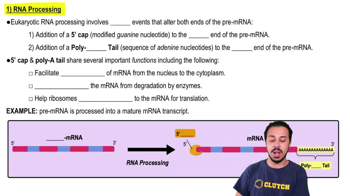
1) RNA Processing

Transcription Process

Transcription is the process by which RNA is synthesized from a DNA template. During transcription, RNA polymerase reads the DNA sequence and assembles a complementary RNA strand using the available nitrogenous bases. The absence of any of the required bases—adenine, cytosine, guanine, or uracil—would halt this process, preventing RNA synthesis. This highlights the importance of each base in forming a complete RNA molecule.
추천 영상:
가이드 코스
04:16
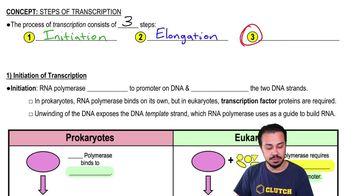
1) Initiation of Transcription

Nitrogenous Bases in RNA

Nitrogenous bases are critical components of nucleotides, which make up RNA and DNA. In RNA, the four bases are adenine (A), cytosine (C), guanine (G), and uracil (U). Each base pairs with its complementary base during the synthesis process, and the absence of any of these bases would disrupt the formation of RNA. Understanding which bases are present in RNA is crucial for answering questions about RNA synthesis.
추천 영상:
가이드 코스
07:21
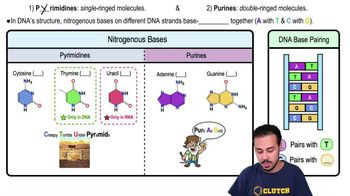
5 Nitrogenous Bases