Ch. 2 Basic Chemistry
Marieb - Essentials of Human Anatomy & Physiology 13th Edition
Marieb13th EditionEssentials of Human Anatomy & PhysiologyISBN: 9780135624340당신이 사용하는 게 아니라요?교과서 변경
2장, 문제 11

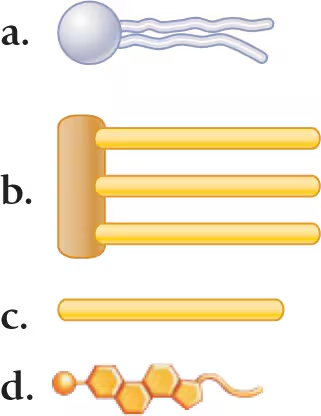
Which of the following forms the basic structure of cell membranes?
Which is the basis for producing sex hormones?
Illustration of four options labeled a, b, c, and d, depicting structures related to cell membranes and hormones.

검증된 단계별 안내
1
Step 1: Understand the basic structure of cell membranes. Cell membranes are primarily composed of a phospholipid bilayer, which consists of hydrophilic (water-attracting) heads and hydrophobic (water-repelling) tails. This structure allows the membrane to be selectively permeable.
Step 2: Recognize the role of lipids in the production of sex hormones. Sex hormones, such as testosterone and estrogen, are derived from cholesterol, which is a type of lipid. Cholesterol serves as the precursor molecule for steroid hormone synthesis.
Step 3: Analyze the options provided in the question. Look for visual or textual clues in the image and options (a, b, c, d) to identify which structure corresponds to phospholipids (for cell membranes) and cholesterol (for sex hormone production).
Step 4: Match the structural features of the molecules in the image to their functions. For example, phospholipids will have a dual-layer structure with hydrophilic heads and hydrophobic tails, while cholesterol will have a characteristic ring structure.
Step 5: Select the correct options based on your analysis. Ensure that the option corresponding to the phospholipid bilayer is chosen for the cell membrane structure and the option corresponding to cholesterol is chosen for the basis of sex hormone production.

비슷한 문제에 대한 검증된 영상 답변:

이 영상 해법은 위 문제에 도움이 된다고 튜터들이 추천한 것입니다.
영상 길이:
1m
도움이 되었나요?

주요 개념

질문에 올바르게 답하기 위해 반드시 이해해야 하는 핵심 개념들은 다음과 같습니다.

Phospholipid Bilayer

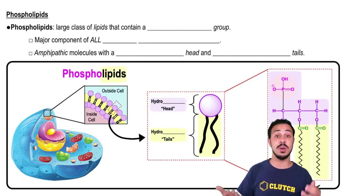
The phospholipid bilayer is the fundamental structure of cell membranes, composed of two layers of phospholipids. Each phospholipid molecule has a hydrophilic (water-attracting) 'head' and two hydrophobic (water-repelling) 'tails.' This arrangement allows the membrane to be selectively permeable, facilitating the movement of substances in and out of the cell while maintaining its integrity.
추천 영상:
04:05
Phospholipids

Steroid Hormones

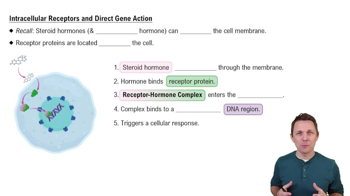
Steroid hormones are a class of hormones derived from cholesterol, which serve as signaling molecules in the body. They include sex hormones such as estrogen and testosterone, which are crucial for reproductive functions and secondary sexual characteristics. The structure of steroid hormones allows them to easily pass through cell membranes and bind to specific receptors, influencing gene expression and cellular activity.
추천 영상:
가이드 코스
5:13
Actions of Steroid Hormones

Cell Membrane Functions

Cell membranes serve multiple essential functions, including protecting the cell's interior, facilitating communication with other cells, and regulating the transport of substances. They contain various proteins that act as receptors, channels, and transporters, enabling the cell to respond to external signals and maintain homeostasis. Understanding these functions is vital for grasping how cells interact with their environment.
추천 영상:
05:33
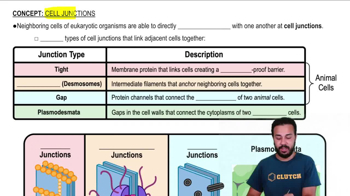
Cell Junctions