Ch. 2 Basic Chemistry
Marieb - Essentials of Human Anatomy & Physiology 13th Edition
Marieb13th EditionEssentials of Human Anatomy & PhysiologyISBN: 9780135624340당신이 사용하는 게 아니라요?교과서 변경
2장, 문제 2

Pick out the correct match(es) of element and number of valence electrons. Draw a planetary model of each atom to help you choose the best answer.
a. Oxygen—6
b. Chlorine—8
c. Phosphorus—5
d. Nitrogen—3
e. Carbon—4

검증된 단계별 안내
1
Step 1: Understand the concept of valence electrons. Valence electrons are the electrons in the outermost shell of an atom, and they determine the chemical properties and bonding behavior of the element. The number of valence electrons corresponds to the group number in the periodic table for main group elements.
Step 2: Refer to the periodic table to identify the group number of each element listed in the problem. For example, oxygen is in Group 16, chlorine is in Group 17, phosphorus is in Group 15, nitrogen is in Group 15, and carbon is in Group 14.
Step 3: Determine the number of valence electrons for each element based on its group number. For main group elements, the number of valence electrons is equal to the group number minus 10 for elements in Groups 13-18. For example, oxygen has 6 valence electrons (Group 16), chlorine has 7 valence electrons (Group 17), phosphorus has 5 valence electrons (Group 15), nitrogen has 5 valence electrons (Group 15), and carbon has 4 valence electrons (Group 14).
Step 4: Draw a planetary model (Bohr model) for each atom to visualize the distribution of electrons in shells. For example, oxygen has 2 electrons in the first shell and 6 in the second shell, chlorine has 2 electrons in the first shell, 8 in the second shell, and 7 in the third shell, and so on. This helps confirm the number of valence electrons.
Step 5: Compare the calculated valence electrons for each element with the options provided in the problem. Match the correct number of valence electrons to the corresponding element. For example, oxygen matches with 6, phosphorus matches with 5, and carbon matches with 4. Eliminate incorrect matches such as chlorine—8 and nitrogen—3.

비슷한 문제에 대한 검증된 영상 답변:

이 영상 해법은 위 문제에 도움이 된다고 튜터들이 추천한 것입니다.
영상 길이:
4m
도움이 되었나요?

주요 개념

질문에 올바르게 답하기 위해 반드시 이해해야 하는 핵심 개념들은 다음과 같습니다.

Valence Electrons

Valence electrons are the outermost electrons of an atom and are crucial in determining how an element reacts chemically. They are involved in forming bonds with other atoms, and the number of valence electrons can often be predicted based on an element's position in the periodic table. For example, elements in the same group typically have the same number of valence electrons.
추천 영상:
07:41
Electron Transport Chain

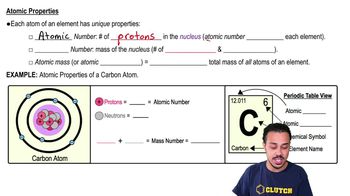
Planetary Model of the Atom

The planetary model of the atom, proposed by Niels Bohr, depicts electrons orbiting the nucleus in defined paths, similar to planets around the sun. This model helps visualize the arrangement of electrons, particularly the distribution of valence electrons in the outer shell. Understanding this model is essential for predicting how atoms will interact and bond with one another.
추천 영상:
07:43
Atomic Properties

Periodic Table Trends

The periodic table organizes elements based on their atomic number and electron configuration, revealing trends in properties such as electronegativity, ionization energy, and the number of valence electrons. Elements in the same group share similar chemical properties due to their identical valence electron counts. Recognizing these trends is vital for accurately matching elements with their corresponding number of valence electrons.
추천 영상:
06:26
Refractory Period