Ch. 2 Basic Chemistry
Marieb - Essentials of Human Anatomy & Physiology 13th Edition
Marieb13th EditionEssentials of Human Anatomy & PhysiologyISBN: 9780135624340당신이 사용하는 게 아니라요?교과서 변경
2장, 문제 1

Which of the following is (are) true concerning the atomic nucleus?
a. It contains the mass of the atom.
b. The negatively charged subatomic particles are here.
c. Subatomic particles can be ejected.
d. It contains subatomic particles that determine atomic number.
e. It contains subatomic particles that interact with other atoms.

검증된 단계별 안내
1
Step 1: Understand the structure of an atom. The atomic nucleus is the central core of an atom, containing protons (positively charged particles) and neutrons (neutral particles). Electrons (negatively charged particles) orbit the nucleus in electron shells.
Step 2: Analyze option (a): 'It contains the mass of the atom.' The nucleus contains protons and neutrons, which contribute almost all the mass of the atom. Electrons have negligible mass in comparison. This statement is true.
Step 3: Analyze option (b): 'The negatively charged subatomic particles are here.' Negatively charged particles (electrons) are not located in the nucleus; they orbit around it. This statement is false.
Step 4: Analyze option (c): 'Subatomic particles can be ejected.' Protons and neutrons in the nucleus can be ejected during nuclear reactions, such as radioactive decay. This statement is true.
Step 5: Analyze options (d) and (e): 'It contains subatomic particles that determine atomic number' and 'It contains subatomic particles that interact with other atoms.' The number of protons in the nucleus determines the atomic number, and protons can interact with other atoms during chemical bonding. Both statements are true.

비슷한 문제에 대한 검증된 영상 답변:

이 영상 해법은 위 문제에 도움이 된다고 튜터들이 추천한 것입니다.
영상 길이:
2m
도움이 되었나요?

주요 개념

질문에 올바르게 답하기 위해 반드시 이해해야 하는 핵심 개념들은 다음과 같습니다.

Atomic Nucleus

The atomic nucleus is the central core of an atom, composed primarily of protons and neutrons. It contains most of the atom's mass due to the high mass of these subatomic particles. The nucleus is positively charged because of the protons, which play a crucial role in determining the atom's identity and properties.
추천 영상:
가이드 코스
07:43
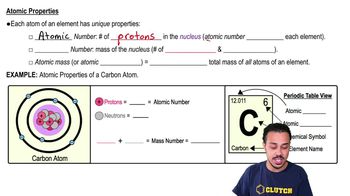
Atomic Properties

Subatomic Particles

Subatomic particles are the fundamental constituents of atoms, including protons, neutrons, and electrons. Protons and neutrons reside in the nucleus, while electrons orbit around it. The number of protons in the nucleus defines the atomic number, which determines the element's identity, while electrons are responsible for chemical bonding and interactions.
추천 영상:
가이드 코스
04:48
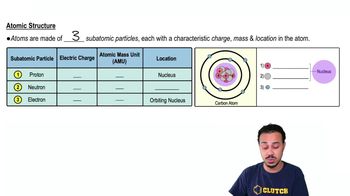
Atomic Structure

Ejection of Subatomic Particles

Subatomic particles can be ejected from the nucleus through processes such as radioactive decay or nuclear reactions. This ejection can lead to the transformation of one element into another, altering the atomic number and mass. Understanding this concept is essential for grasping nuclear chemistry and the behavior of radioactive materials.
추천 영상:
가이드 코스
04:48
Atomic Structure