Ch. 5 The Skeletal System
Marieb - Essentials of Human Anatomy & Physiology 13th Edition
Marieb13th EditionEssentials of Human Anatomy & PhysiologyISBN: 9780135624340당신이 사용하는 게 아니라요?교과서 변경
5장, 문제 20

Compare the amount of movement possible in synarthrotic, amphiarthrotic, and diarthrotic joints. Relate these terms to the structural classification of joints—that is, to fibrous, cartilaginous, and synovial joints.

검증된 단계별 안내
1
Understand the three functional classifications of joints based on their range of movement: synarthrotic (immovable), amphiarthrotic (slightly movable), and diarthrotic (freely movable). These terms describe how much movement is possible at a joint.
Relate the functional classifications to the structural classifications of joints: fibrous, cartilaginous, and synovial. Structural classification is based on the type of connective tissue and whether a joint cavity is present.
Synarthrotic joints are typically associated with fibrous joints, such as sutures in the skull, where bones are tightly connected by fibrous connective tissue and allow no movement.
Amphiarthrotic joints are often associated with cartilaginous joints, such as the intervertebral discs or the pubic symphysis, where cartilage allows limited movement between bones.
Diarthrotic joints correspond to synovial joints, which have a joint cavity filled with synovial fluid, allowing a wide range of movement. Examples include the shoulder, hip, and knee joints.

비슷한 문제에 대한 검증된 영상 답변:

이 영상 해법은 위 문제에 도움이 된다고 튜터들이 추천한 것입니다.
영상 길이:
4m
도움이 되었나요?

주요 개념

질문에 올바르게 답하기 위해 반드시 이해해야 하는 핵심 개념들은 다음과 같습니다.

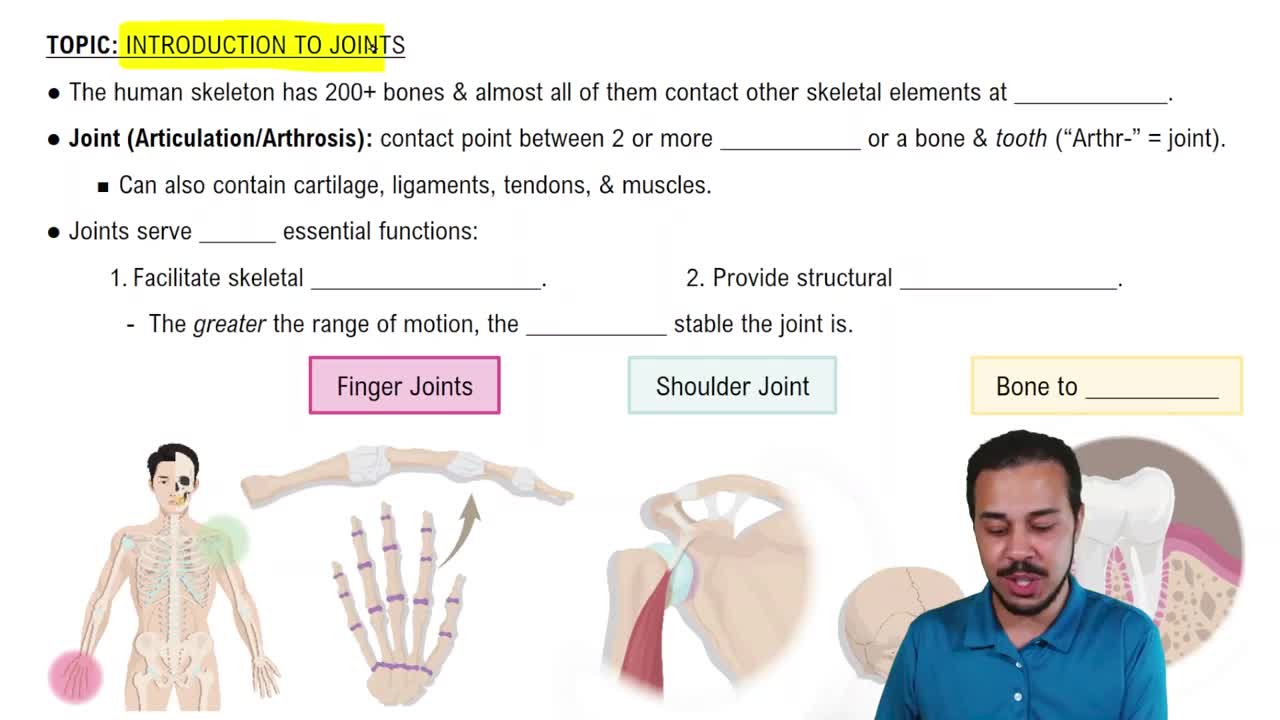
Types of Joints

Joints are classified based on their movement capabilities into three main types: synarthrotic, amphiarthrotic, and diarthrotic. Synarthrotic joints allow no movement (e.g., sutures in the skull), amphiarthrotic joints permit limited movement (e.g., the pubic symphysis), and diarthrotic joints enable a wide range of motion (e.g., the knee and elbow). Understanding these classifications is essential for analyzing joint function.
추천 영상:
가이드 코스
05:39
Introduction to Joints

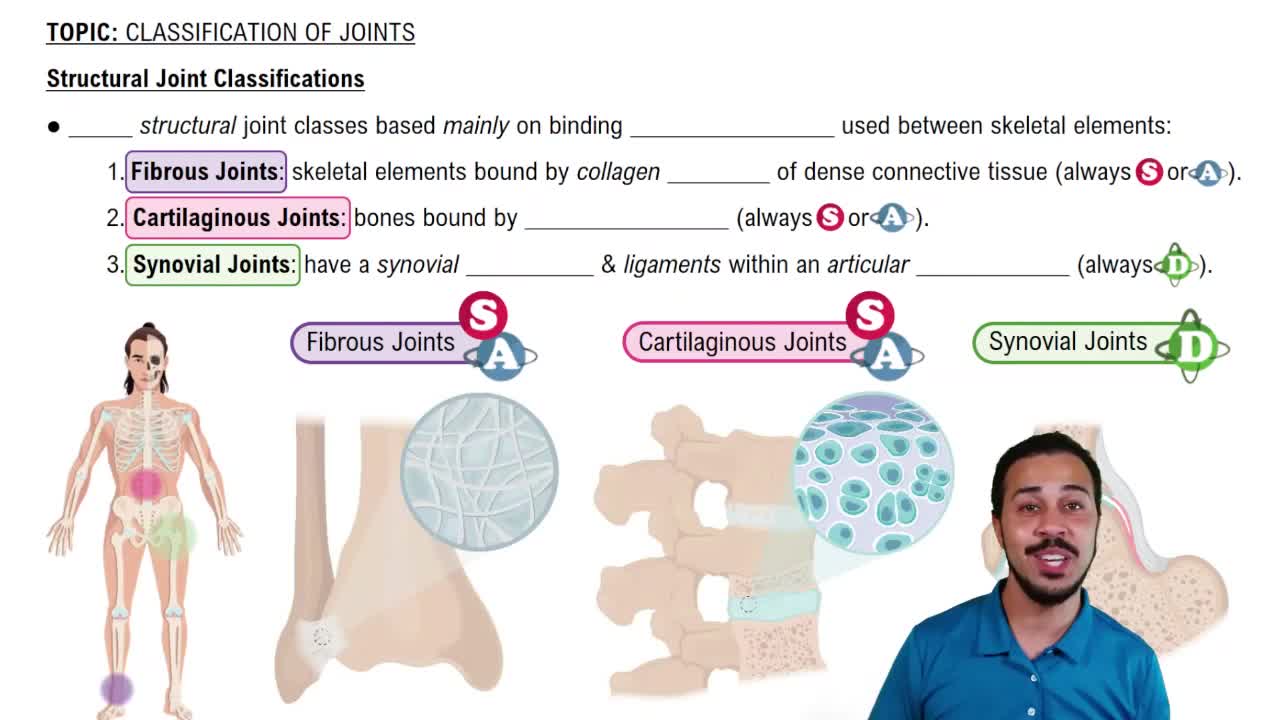
Structural Classification of Joints

Joints can also be categorized structurally into fibrous, cartilaginous, and synovial joints. Fibrous joints, such as sutures, are connected by dense connective tissue and are typically immovable. Cartilaginous joints, like the intervertebral discs, allow slight movement, while synovial joints are characterized by a fluid-filled cavity that facilitates extensive movement, making them the most mobile type of joint.
추천 영상:
가이드 코스
08:25
Structural Joint Classifications

Functional vs. Structural Classification

The functional classification of joints (synarthrotic, amphiarthrotic, diarthrotic) focuses on the degree of movement, while the structural classification (fibrous, cartilaginous, synovial) emphasizes the anatomical features of the joints. These classifications are interrelated; for instance, synarthrotic joints are typically fibrous, whereas diarthrotic joints are always synovial. Understanding both classifications helps in comprehending joint mechanics and their roles in the skeletal system.
추천 영상:
가이드 코스
08:25
Structural Joint Classifications