Ch. 9 The Endocrine System
Marieb - Essentials of Human Anatomy & Physiology 13th Edition
Marieb13th EditionEssentials of Human Anatomy & PhysiologyISBN: 9780135624340당신이 사용하는 게 아니라요?교과서 변경
9장, 문제 15

Name two endocrine-producing glands (or regions) that are important in the stress response, and explain why they are important.

검증된 단계별 안내
1
Identify the two primary endocrine-producing glands involved in the stress response: the adrenal glands and the hypothalamus.
Explain the role of the adrenal glands: The adrenal glands consist of two regions, the adrenal medulla and the adrenal cortex. The adrenal medulla releases catecholamines (epinephrine and norepinephrine) during the 'fight or flight' response, while the adrenal cortex produces glucocorticoids (like cortisol) that help regulate metabolism, immune response, and energy availability during prolonged stress.
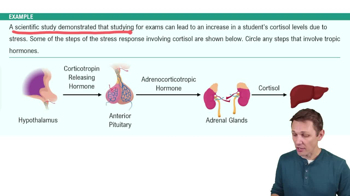
Describe the role of the hypothalamus: The hypothalamus is a key regulator of the stress response. It releases corticotropin-releasing hormone (CRH), which stimulates the pituitary gland to release adrenocorticotropic hormone (ACTH). ACTH then signals the adrenal cortex to produce cortisol, a critical hormone for managing stress.
Discuss the importance of these glands: The adrenal glands and hypothalamus work together to ensure the body can respond effectively to both acute and chronic stress. The hypothalamus initiates the stress response, while the adrenal glands execute the physiological changes needed to adapt to stressors.
Highlight the physiological significance: These glands are essential for maintaining homeostasis during stress by regulating heart rate, blood pressure, energy metabolism, and immune function, ensuring the body can cope with challenges effectively.

비슷한 문제에 대한 검증된 영상 답변:

이 영상 해법은 위 문제에 도움이 된다고 튜터들이 추천한 것입니다.
영상 길이:
2m
도움이 되었나요?

주요 개념

질문에 올바르게 답하기 위해 반드시 이해해야 하는 핵심 개념들은 다음과 같습니다.

Adrenal Glands

The adrenal glands, located on top of each kidney, play a crucial role in the stress response by producing hormones such as cortisol and adrenaline. Cortisol helps regulate metabolism and immune response, while adrenaline prepares the body for 'fight or flight' by increasing heart rate and energy availability. Their coordinated action is essential for managing stress and maintaining homeostasis.
추천 영상:
2:38
The Hypothalamus and Pituitary Gland Example 1

Hypothalamus-Pituitary-Adrenal (HPA) Axis

The HPA axis is a complex set of interactions between the hypothalamus, pituitary gland, and adrenal glands that regulates the body's response to stress. When faced with stress, the hypothalamus releases corticotropin-releasing hormone (CRH), stimulating the pituitary to secrete adrenocorticotropic hormone (ACTH), which in turn prompts the adrenal glands to produce cortisol. This feedback loop is vital for adapting to stressors.
추천 영상:
6:11
The Hypothalamus and Pituitary Gland Example 3

Sympathetic Nervous System

The sympathetic nervous system is part of the autonomic nervous system that activates the body's 'fight or flight' response during stressful situations. It triggers the release of adrenaline from the adrenal medulla, leading to physiological changes such as increased heart rate, heightened alertness, and energy mobilization. This rapid response is essential for immediate survival in threatening situations.
추천 영상:
1:21
Sympathetic Nervous System Example 3