뒤로
뒤로
문제 1a
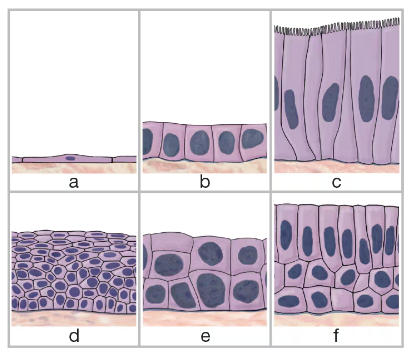
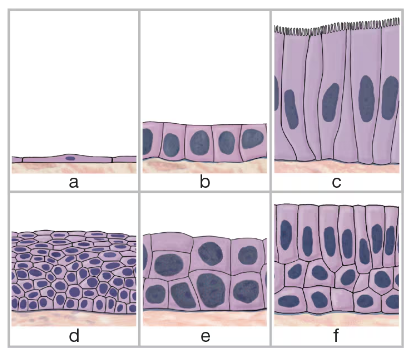
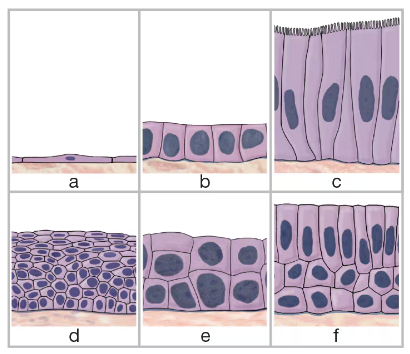
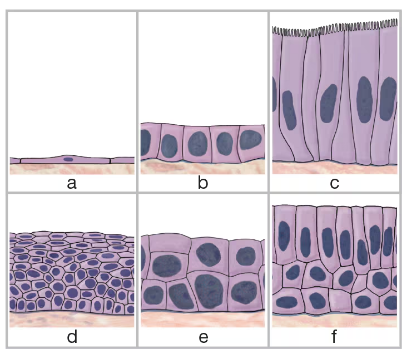
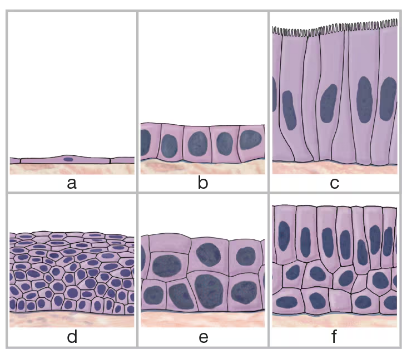
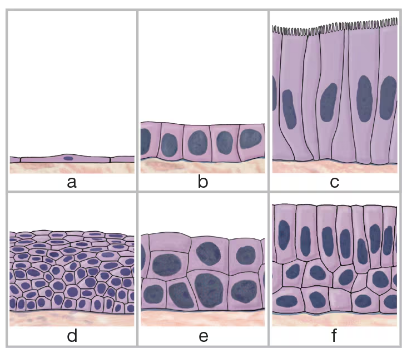
Identify the six types of epithelial tissue shown in the drawing below.
a. __
문제 1b
Identify the six types of epithelial tissue shown in the drawing below.
b. ___
문제 1c
Identify the six types of epithelial tissue shown in the drawing below.
c. ___
문제 1d
Identify the six types of epithelial tissue shown in the drawing below.
d. ___
문제 1e
Identify the six types of epithelial tissue shown in the drawing below.
e. ___
문제 1f
Identify the six types of epithelial tissue shown in the drawing below.
f. ___
문제 2
Collections of specialized cells and cell products that perform a relatively limited number of functions are called
(a) Cellular aggregates,
(b) Tissues
(c) Organs
(d) Organ systems
(e) Organisms
문제 3
Tissue that is specialized for contraction is
(a) Epithelial tissue
(b) Muscle tissue
(c) Connective tissue
(d) Nervous tissue
문제 4
A type of cell junction common in cardiac and smooth muscle tissues is the
(a) Hemidesmosome
(b) Basal junction
(c) Tight junction
(d) Gap junction
문제 5
The most abundant connections between cells in the superficial layers of the skin are
(a) Connexons
(b) Gap junctions
(c) Desmosomes
(d) Tight junctions
문제 8
Matrix is a characteristic of which type of tissue?
(a) Epithelial
(b) Nervous
(c) Muscle
(d) Connective
문제 9
Which of the following epithelia most easily permits diffusion?
(a) Stratified squamous
(b) Simple squamous
(c) Transitional
(d) Simple columnar
문제 10
Functions of connective tissue include
(a) Establishing a structural framework for the body
(b) Storing energy reserves
(c) Providing protection for delicate organs
(d) All of these
(e) a and c only.
문제 11
The three major types of cartilage in the body are
(a) Collagen, reticular, and elastic
(b) Areolar, adipose, and reticular
(c) Hyaline, elastic, and fibrous
(d) Tendons, reticular, and elastic
문제 13
The type of cartilage growth characterized by adding new layers of cartilage to the surface is
(a) Interstitial growth
(b) Appositional growth
(c) Intramembranous growth
(d) Longitudinal growth.
문제 15
Axons, dendrites, and a cell body are characteristic of cells located in
(a) Nervous tissue
(b) Muscle tissue
(c) Connective tissue
(d) Epithelial tissue
문제 17
What are the four essential functions of epithelial tissue?
문제 20
List three basic components of connective tissues.
문제 22
What two cell populations make up nervous tissue? What is the function of each?
문제 25
Describe the fluid connective tissues in the human body. What are the main differences between fluid connective tissues and supporting connective tissues?
문제 27
A layer of glycoproteins and a network of fine protein filaments that prevents the movement of proteins and other large molecules from the connective tissue to the epithelium describe
(a) Interfacial canals
(b) The basement membrane
(c) The reticular lamina
(d) Areolar tissue
(e) Squamous epithelium
문제 28
Why does damaged cartilage heal slowly?
(a) Chondrocytes cannot be replaced if killed, and other cell types must take their place.
(b) Cartilage is avascular, so nutrients and other molecules must diffuse to the site of injury.
(c) Damaged cartilage becomes calcified, thus blocking the movement of materials required for healing.
(d) Chondrocytes divide more slowly than other cell types, delaying the healing process.
(e) Damaged collagen cannot be quickly replaced, thereby slowing the healing process.
문제 29
List the similarities and differences among the three types of muscle tissue.
문제 31
During a lab practical, a student examines a tissue that is composed of densely packed protein fibers that run parallel to each other and form a cord. There are no striations, but small nuclei are visible. The student identifies the tissue as skeletal muscle. Why is the student's choice wrong, and what tissue is he probably observing?