Ch. 27 - Diversification of Eukaryotes
Freeman - Biological Science 8th Edition
Freeman8th EditionBiological ScienceISBN: 9780138276263당신이 사용하는 게 아니라요?교과서 변경
27장, 문제 8

The text claims that the evolutionary history of protists can be understood as a series of morphological innovations that established seven distinct lineages, each of which subsequently diversified based on innovative ways of feeding, moving, and reproducing. Explain how the Alveolata support this claim.

검증된 단계별 안내
1
Step 1: Understand the question. The question is asking you to explain how the Alveolata, a group of protists, supports the claim that the evolutionary history of protists can be understood as a series of morphological innovations that established distinct lineages, each of which subsequently diversified based on innovative ways of feeding, moving, and reproducing.
Step 2: Research the Alveolata. Alveolata is a major group of protists which includes organisms like dinoflagellates, apicomplexans, and ciliates. They are characterized by the presence of alveoli, or small vesicles, beneath their cell membranes. These alveoli are thought to provide support to the cell surface.
Step 3: Identify the morphological innovations in Alveolata. The presence of alveoli is a morphological innovation that distinguishes Alveolata from other protists. Additionally, different groups within the Alveolata have other unique features. For example, dinoflagellates have two flagella for movement, apicomplexans have a unique organelle called an apicoplast, and ciliates have cilia for movement.
Step 4: Explain how these innovations led to diversification. The unique features of each group within the Alveolata allowed them to adapt to different environments and lifestyles. For example, the flagella of dinoflagellates allow them to move in water, the apicoplast of apicomplexans is thought to be involved in processes like lipid synthesis, and the cilia of ciliates allow them to move and feed.
Step 5: Summarize your findings. The Alveolata support the claim that the evolutionary history of protists can be understood as a series of morphological innovations that established distinct lineages, each of which subsequently diversified based on innovative ways of feeding, moving, and reproducing. The presence of alveoli and other unique features in different groups within the Alveolata allowed them to adapt to different environments and lifestyles, leading to their diversification.

비슷한 문제에 대한 검증된 영상 답변:

이 영상 해법은 위 문제에 도움이 된다고 튜터들이 추천한 것입니다.
영상 길이:
1m
도움이 되었나요?

주요 개념

질문에 올바르게 답하기 위해 반드시 이해해야 하는 핵심 개념들은 다음과 같습니다.

Morphological Innovations

Morphological innovations refer to significant changes in the structure and form of organisms that can lead to the emergence of new traits or lineages. In the context of protists, these innovations may include adaptations in cell structure, such as the development of specialized organelles or unique shapes, which enable them to exploit different ecological niches and enhance survival.
추천 영상:
08:17
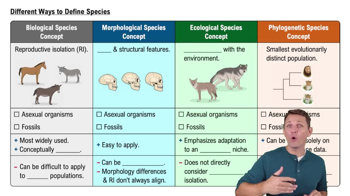
Different Ways to Define Species

Alveolata

Alveolata is a major group of protists characterized by the presence of alveoli, which are membrane-bound sacs located beneath the plasma membrane. This group includes diverse organisms such as ciliates, dinoflagellates, and apicomplexans, each exhibiting unique feeding, movement, and reproductive strategies that illustrate the evolutionary adaptations stemming from their morphological innovations.
추천 영상:
가이드 코스
10:24
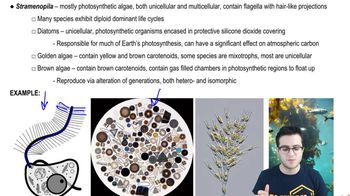
Stramenopila and Alveolata

Diversity in Feeding, Movement, and Reproduction

The diversity in feeding, movement, and reproduction among protists, particularly within the Alveolata, highlights how morphological innovations can lead to varied ecological strategies. For instance, dinoflagellates possess unique flagella for movement and can photosynthesize, while apicomplexans have evolved complex life cycles for reproduction, showcasing how these adaptations contribute to their evolutionary success and ecological roles.
추천 영상:
가이드 코스
08:24
Food and Feeding
관련 실천
교과서 질문

Consider the endosymbiosis theory for the origin of the mitochondrion. How did each endosymbiotic partner benefit from the relationship?

2177
views
1
rank
교과서 질문

Consider the following:

Plasmodium has an unusual organelle called an apicoplast. Recent research has shown that apicoplasts are derived from chloroplasts via secondary endosymbiosis and have a large number of genes related to chloroplast DNA.

Glyphosate is one of the most widely used herbicides. It works by poisoning an enzyme located in chloroplasts.

Biologists are testing the hypothesis that glyphosate could be used as an antimalarial drug in humans.

How are these observations connected?

623
views
교과서 질문

Suppose a friend says that we don't need to worry about the rising temperatures associated with global climate change. She claims that increased temperatures will make planktonic algae grow faster and that carbon dioxide (CO2) will be removed from the atmosphere faster. According to her, this carbon will be buried at the bottom of the ocean in calcium carbonate shells. As a result, the amount of carbon dioxide in the atmosphere will decrease and global warming will decline. Comment.

630
views
교과서 질문

Why was finding a close relationship between mitochondrial DNA and bacterial DNA considered particularly strong evidence in favor of the endosymbiosis theory?

2270
views
교과서 질문

When placed at the perimeter of a maze with food in the center, the plasmodial slime mold Physarum polycephalum explores the maze, retracts branches from dead-end corridors, and then grows exclusively along the shortest path possible to the food. How does Physarum do this? One theory is that it leaves behind slime deposits—an externalized 'memory' that 'reminds' it not to retry dead ends. Which of the following best describes movement in Physarum?

a. Cilia propel the slime mold.

b. Flagella propel the slime mold.

c. The slime mold moves by amoeboid motion.

d. The slime mold moves by gliding motility.

573
views
교과서 질문

Explain the logic behind the claim that the nuclear envelope is a synapomorphy that defines eukaryotes as a monophyletic group.

658
views