
Ch. 3 - Derivatives
Briggs - Calculus: Early Transcendentals 3rd Edition
Briggs3rd EditionCalculus: Early TranscendentalsISBN: 9780136847243당신이 사용하는 게 아니라요?교과서 변경
3장, 문제 3.2.64

A line perpendicular to another line or to a tangent line is often called a normal line. Find an equation of the line perpendicular to the line that is tangent to the following curves at the given point P.
y= √x; P(4, 2)

검증된 단계별 안내
1
Step 1: Find the derivative of the function y = \(\sqrt{x}\). The derivative, y', represents the slope of the tangent line at any point x. Use the power rule for derivatives: if y = x^{1/2}, then y' = \(\frac{1}{2}\)x^{-1/2}.
Step 2: Evaluate the derivative at the given point P(4, 2) to find the slope of the tangent line. Substitute x = 4 into the derivative y' = \(\frac{1}{2}\)x^{-1/2} to find the slope at x = 4.
Step 3: Determine the slope of the line perpendicular to the tangent line. The slope of the normal line is the negative reciprocal of the slope of the tangent line. If the slope of the tangent line is m, then the slope of the normal line is -1/m.
Step 4: Use the point-slope form of a line to write the equation of the normal line. The point-slope form is y - y_1 = m(x - x_1), where m is the slope of the normal line and (x_1, y_1) is the point P(4, 2).
Step 5: Substitute the slope of the normal line and the coordinates of point P into the point-slope form equation to find the equation of the normal line.

비슷한 문제에 대한 검증된 영상 답변:

이 영상 해법은 위 문제에 도움이 된다고 튜터들이 추천한 것입니다.
영상 길이:
4m
도움이 되었나요?

주요 개념

질문에 올바르게 답하기 위해 반드시 이해해야 하는 핵심 개념들은 다음과 같습니다.

Tangent Line

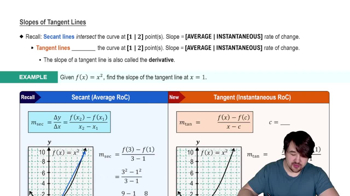
A tangent line to a curve at a given point is a straight line that touches the curve at that point without crossing it. The slope of the tangent line represents the instantaneous rate of change of the function at that point, which can be found using the derivative of the function.
추천 영상:
가이드 코스
05:13
Slopes of Tangent Lines

Normal Line

A normal line is a line that is perpendicular to the tangent line at a given point on a curve. Its slope is the negative reciprocal of the slope of the tangent line. This relationship is crucial for finding the equation of the normal line once the slope of the tangent is determined.
추천 영상:
가이드 코스
05:13
Slopes of Tangent Lines

Finding the Derivative

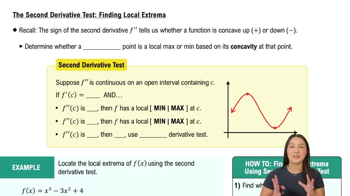
Finding the derivative of a function is a fundamental concept in calculus that allows us to determine the slope of the tangent line at any point on the curve. For the function y = √x, the derivative can be calculated using power rules, which will then be evaluated at the specific point P(4, 2) to find the slope needed for both the tangent and normal lines.
추천 영상:
06:02
The Second Derivative Test: Finding Local Extrema
관련 실천
교과서 질문

Watching an elevator An observer is 20 m above the ground floor of a large hotel atrium looking at a glass-enclosed elevator shaft that is 20 m horizontally from the observer (see figure). The angle of elevation of the elevator is the angle that the observer’s line of sight makes with the horizontal (it may be positive or negative). Assuming the elevator rises at a rate of 5 m/s, what is the rate of change of the angle of elevation when the elevator is 10 m above the ground? When the elevator is 40 m above the ground? <IMAGE>

259
views
교과서 질문

Find y'' for the following functions.

y = tan x

357
views
교과서 질문

Find d/dx (In(xe^x)) without using the Chain Rule and the Product Rule.

386
views
교과서 질문

Derivatives Find the derivative of the following functions. See Example 2 of Section 3.2 for the derivative of √x.

f(s) = √s/4

272
views
교과서 질문

Matching heights A stone is thrown with an initial velocity of 32 ft/s from the edge of a bridge that is 48 ft above the ground. The height of this stone above the ground t seconds after it is thrown is f(t) = −16t²+32t+48 . If a second stone is thrown from the ground, then its height above the ground after t seconds is given by g(t) = −16t²+v0t, where v0 is the initial velocity of the second stone. Determine the value of v0 such that both stones reach the same high point.

290
views
교과서 질문

Water is drained out of an inverted cone that has the same dimensions as the cone depicted in Exercise 36. If the water level drops at 1 ft/min, at what rate is water (in ft³/min) draining from the tank when the water depth is 6 ft? 

362
views