Ch. 3 - Derivatives
Briggs - Calculus: Early Transcendentals 3rd Edition
Briggs3rd EditionCalculus: Early TranscendentalsISBN: 9780136847243당신이 사용하는 게 아니라요?교과서 변경
3장, 문제 3.11.45

Watching an elevator An observer is 20 m above the ground floor of a large hotel atrium looking at a glass-enclosed elevator shaft that is 20 m horizontally from the observer (see figure). The angle of elevation of the elevator is the angle that the observer’s line of sight makes with the horizontal (it may be positive or negative). Assuming the elevator rises at a rate of 5 m/s, what is the rate of change of the angle of elevation when the elevator is 10 m above the ground? When the elevator is 40 m above the ground? <IMAGE>

검증된 단계별 안내
1
Step 1: Define the variables. Let \( \theta \) be the angle of elevation, \( y \) be the height of the elevator above the ground, and \( x \) be the horizontal distance from the observer to the elevator shaft, which is constant at 20 m.
Step 2: Use trigonometry to relate \( \theta \) and \( y \). The tangent of the angle \( \theta \) is given by \( \tan(\theta) = \frac{y}{x} \). Since \( x = 20 \) m, we have \( \tan(\theta) = \frac{y}{20} \).
Step 3: Differentiate both sides of the equation \( \tan(\theta) = \frac{y}{20} \) with respect to time \( t \). Use the chain rule: \( \sec^2(\theta) \frac{d\theta}{dt} = \frac{1}{20} \frac{dy}{dt} \).
Step 4: Substitute the given rate of change of the elevator's height, \( \frac{dy}{dt} = 5 \) m/s, into the differentiated equation: \( \sec^2(\theta) \frac{d\theta}{dt} = \frac{1}{20} \times 5 \).
Step 5: Solve for \( \frac{d\theta}{dt} \) when \( y = 10 \) m and \( y = 40 \) m. First, find \( \theta \) using \( \tan(\theta) = \frac{y}{20} \) for each case, then calculate \( \sec^2(\theta) \), and finally find \( \frac{d\theta}{dt} \) using the equation from Step 4.

비슷한 문제에 대한 검증된 영상 답변:

이 영상 해법은 위 문제에 도움이 된다고 튜터들이 추천한 것입니다.
영상 길이:
6m
도움이 되었나요?

주요 개념

질문에 올바르게 답하기 위해 반드시 이해해야 하는 핵심 개념들은 다음과 같습니다.

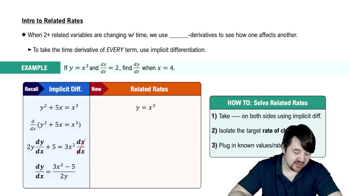
Related Rates

Related rates are a concept in calculus that deals with the relationship between the rates of change of two or more variables. In this scenario, the angle of elevation changes as the height of the elevator changes, and we need to find the rate at which this angle changes with respect to time. This involves using derivatives to relate the rates of change of the angle and the height of the elevator.
추천 영상:
가이드 코스
04:16
Intro To Related Rates

Trigonometric Functions

Trigonometric functions, such as sine, cosine, and tangent, are essential for analyzing angles and distances in right triangles. In this problem, the angle of elevation can be expressed using the tangent function, which relates the height of the elevator to the horizontal distance from the observer. Understanding how to manipulate these functions is crucial for finding the angle of elevation and its rate of change.
추천 영상:
가이드 코스
6:04
Introduction to Trigonometric Functions

Implicit Differentiation

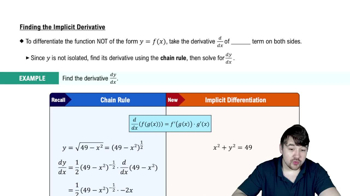
Implicit differentiation is a technique used to differentiate equations that define one variable in terms of another without explicitly solving for one variable. In this context, we can use implicit differentiation to find the derivative of the angle of elevation with respect to time, allowing us to determine how quickly the angle changes as the elevator ascends. This method is particularly useful when dealing with relationships that involve multiple variables.
추천 영상:
가이드 코스
05:14
Finding The Implicit Derivative